

AI Chatbot Terminology Explained: Essential Concepts for E-commerce
Customer support decisions can get complicated the moment technical buzzwords start flying. For E-commerce managers in Canada, the United States, and beyond, knowing the real meaning behind AI chatbot terms matters because it shapes how your team serves shoppers every day. This guide untangles generative AI myths, explains key concepts in simple language, and gives you practical knowledge to build smarter customer support with fewer surprises.
Table of Contents
- Defining Key AI Chatbot Terms And Myths
- Chatbot Types: Rule-Based Vs. AI-Powered
- How AI Chatbots Integrate With Your Store
- Customer Support Use Cases And Benefits
- Common Chatbot Misunderstandings To Avoid
Key Takeaways
| Point | Details |
|---|---|
| Understanding AI Chatbots | AI chatbots use generative AI to simulate human conversation, but they lack true comprehension and cannot fact-check information. |
| Rule-Based vs. AI-Powered | Choose between rule-based chatbots for predictable tasks and AI-powered chatbots for handling diverse customer inquiries effectively. |
| Integration Importance | Proper integration into your e-commerce platform allows chatbots to provide personalized support using real-time data from your knowledge base. |
| Misunderstandings to Avoid | Recognize that chatbots do not replace human agents but assist them, and ensure your training data is accurate to improve performance. |
Defining Key AI Chatbot Terms and Myths
When you start exploring AI chatbots for your e-commerce business, you’ll encounter terminology that sounds technical and intimidating. The good news? Most concepts boil down to straightforward ideas. Understanding what these terms actually mean, rather than what marketing materials suggest, helps you make smarter decisions about your customer support strategy.
Let’s start with what AI chatbots actually are. An AI chatbot is a software tool that simulates human conversation through text or voice. Unlike simple automated responses triggered by keywords, modern chatbots use generative AI to understand context and produce natural language responses. When you set up a chatbot using platforms designed for e-commerce, like those integrated with Shopify or WordPress, the tool learns from your product information and support documentation to answer customer questions in real time.
Here’s where myths creep in. Many business owners believe chatbots “understand” their customers in a human sense or that they independently verify information for accuracy. That’s not how they work. Generative AI chatbots operate through statistical language patterns derived from training data. They generate responses based on patterns they’ve learned, not from genuine comprehension or fact checking. Your chatbot will produce confident-sounding answers even when it’s working from incomplete or outdated information. This is why feeding your chatbot accurate product details and support guidelines matters enormously.
Another common misunderstanding involves the term Large Language Models (LLMs). These are the underlying AI systems that power your chatbot’s brain. Think of an LLM as a pattern recognition engine trained on massive amounts of text. It predicts the next word, then the word after that, building responses one token at a time. When your e-commerce chatbot explains a return policy or processes an order inquiry, it’s using an LLM to generate that response.
The real power for your business comes from understanding what chatbots can actually do. AI chatbots function as virtual assistants that handle routine customer questions, reduce response time from hours to seconds, and free your team for complex issues. They excel at consistent, 24/7 availability. Where they fall short is creative problem solving, understanding nuanced customer emotions, and handling situations requiring genuine human judgment. That’s why human handoff capabilities matter. You need a seamless transition from your chatbot to a real team member when customers hit issues your bot can’t resolve.
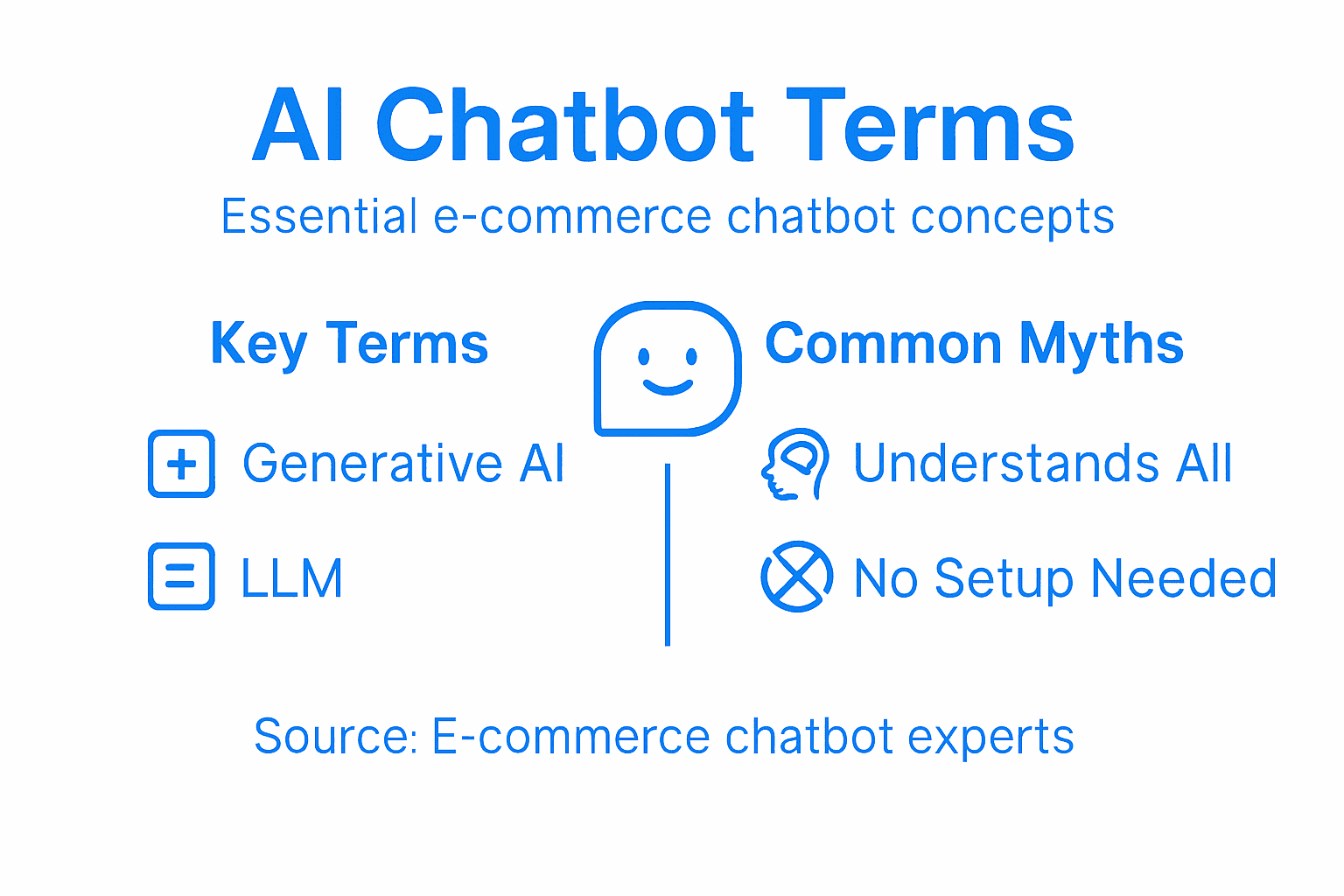
One final myth worth addressing: the belief that deploying a chatbot requires extensive setup and technical knowledge. Modern platforms simplify this dramatically. You upload your knowledge base, customize the chatbot’s personality to match your brand voice, and deploy it without writing a single line of code. The bot learns from your actual content, reducing hallucinations and irrelevant responses.
Pro tip: Start by identifying the 10 most frequent customer questions your team answers each week. Feed those exact questions and answers into your chatbot during setup, and you’ll see immediate accuracy improvements while your team focuses on customers with complex needs.
Chatbot Types: Rule-Based vs. AI-Powered
Your e-commerce business needs customer support, but not all chatbots work the same way. The choice between rule-based and AI-powered chatbots fundamentally shapes how your customers experience your brand and how efficiently your team operates. Understanding the difference between these two approaches helps you pick the right tool for your specific needs.
Rule-based chatbots operate on fixed scripts and predetermined decision trees. Imagine a flowchart where each customer answer triggers a specific next question or response. If a customer types “Where is my order,” the bot follows a script branch to ask for an order number, then provides tracking information from a predefined database. These chatbots work beautifully for repetitive, straightforward tasks. They’re predictable, easy to build, and require no machine learning complexity. However, they hit a wall immediately when customers deviate from expected paths or ask something slightly different than the script anticipates.
AI-powered chatbots operate differently. They use natural language processing and machine learning to understand intent and context rather than matching keywords to scripts. When a customer asks “When will my package show up?” or “Has my delivery shipped yet,” the AI chatbot recognizes these questions mean the same thing, even though the wording differs. It understands nuance, learns from conversations, and adapts its responses. This flexibility matters enormously in e-commerce where customers phrase questions countless different ways.

For your specific situation, consider what customer questions actually look like. Are most inquiries predictable and repetitive? Do customers usually stay within expected topics? A rule-based approach works fine and costs less to implement. But if your customers ask varied questions about products, policies, shipping, and returns across multiple scenarios, an AI-powered chatbot handles this complexity naturally. It learns from your actual product catalog and support documentation, answering questions you never specifically programmed it to handle.
The real distinction shows up in scaling. As your e-commerce business grows, rule-based chatbots require constant manual updates. Every new product, policy change, or seasonal promotion means rebuilding decision trees. AI-powered chatbots adapt automatically when you update your knowledge base. You upload new product information once, and your chatbot immediately incorporates it into responses across thousands of conversations.
Here is a concise comparison of rule-based and AI-powered chatbots for e-commerce support:
| Key Difference | Rule-Based Chatbot | AI-Powered Chatbot |
|---|---|---|
| Handling Variations | Struggles with new phrasing | Adapts to varied questions |
| Update Requirements | Frequent manual edits | Automatic updates from knowledge |
| Initial Setup Effort | Simple, few configurations | Needs well-structured data upload |
| Scalability | Limited, hard to maintain | Highly scalable for growth |
Pro tip: Start with an AI-powered chatbot if you handle diverse customer inquiries, but structure your knowledge base with clear product categories and FAQs so the bot learns efficiently from organized information.
How AI Chatbots Integrate With Your Store
Integrating an AI chatbot into your e-commerce store sounds technical, but the process works smoothly with modern platforms. Your chatbot doesn’t operate in isolation. It connects directly to your store’s ecosystem, learning from your product data, inventory, and customer history to deliver personalized support at scale.
The integration starts with your knowledge base. Whether you run Shopify, WordPress, Wix, or Webflow, you feed your chatbot information about your products, policies, and FAQs. The chatbot then uses this data to answer customer questions in real time. When a customer asks about shipping costs, return policies, or product specifications, your chatbot pulls from this centralized information source rather than guessing or providing outdated details.
AI chatbots integrate across customer service, personalization, and marketing workflows to handle multiple functions simultaneously. A single chatbot can qualify leads, answer product questions, manage abandoned carts, and guide customers through checkout. This multi-functional approach means you’re not running separate tools for each task. One chatbot handles it all while your team focuses on customers with genuinely complex needs.
The real power shows up in customer interaction. Your chatbot provides 24/7 availability while collecting valuable conversation data. Every question a customer asks feeds back into your understanding of what information gaps exist. If customers repeatedly ask about a specific product detail, you know that detail needs clearer placement on your product pages. If they struggle with checkout, your chatbot interaction patterns reveal where friction exists.
Integration also means seamless handoff to humans. When a customer’s issue exceeds your chatbot’s capabilities, it escalates to your support team with full conversation context. Your team member sees the entire chat history, understands exactly what the customer asked, and jumps in without the customer repeating themselves. This creates continuity that customers genuinely appreciate.
The technical setup requires no coding knowledge. Modern platforms handle the backend connections automatically. You simply upload your content, configure response styles to match your brand voice, and deploy. The platform manages API connections, data security, and system updates behind the scenes.
Pro tip: Map your top 20 customer journey touchpoints before setup, then ensure your knowledge base covers each one comprehensively so your chatbot handles 80% of interactions without human intervention.
Customer Support Use Cases and Benefits
AI chatbots transform customer support from a cost center into a competitive advantage. The real value appears not just in automation, but in how chatbots enhance your team’s ability to deliver exceptional service at scale. Understanding the specific use cases and measurable benefits helps you justify the investment and set realistic expectations.
The most immediate use case is answering repetitive questions. Customers ask the same things constantly: “What are your shipping times?” “Can I return this item?” “Where is my order?” Your chatbot handles these instantly, 24/7. This frees your support team from answering the same questions hundreds of times daily, redirecting their energy toward complex issues requiring human judgment and empathy.
Order management represents another powerful use case. Customers can track shipments, request cancellations, initiate returns, and check order status through your chatbot without waiting for a human agent. Your team gets fewer repetitive inquiries and more time for customers with genuine problems. The automation also means faster resolution for routine requests. A customer doesn’t wait 8 hours for someone to look up their tracking number.
Product recommendations and upselling happen naturally through chatbot conversations. AI chatbots improve customer experience through personalized, context-aware responses that feel helpful rather than pushy. When a customer asks about a winter jacket, your chatbot suggests matching accessories or mentions a related sale. This drives incremental revenue while improving the shopping experience.
The benefits compound across your business. Your support team becomes more effective because chatbots handle volume, leaving them fresh for complex interactions requiring genuine problem solving. Response times drop dramatically. Customers get answers in seconds rather than hours. AI chatbots complement human agents by helping them respond more quickly and empathetically, particularly benefiting less experienced team members who now have intelligent assistance. Customer satisfaction increases. Customers prefer quick answers to waiting, and they appreciate support available on their schedule, not yours.
Operational costs decrease significantly. You’re not hiring additional support staff to handle volume growth. Your existing team handles more inquiries with less stress. The chatbot captures conversation data revealing what questions customers repeatedly ask, what frustrates them, and where your product information falls short. This intelligence guides product improvements and website updates.
Below is a quick reference summary of top business benefits when integrating AI chatbots in customer support:
| Benefit | Business Impact | Team Advantage |
|---|---|---|
| Faster Response Times | Higher customer satisfaction | Reduces agent workload |
| 24/7 Availability | Captures sales out of hours | Ensures coverage |
| Data Collection | Pinpoints info gaps, trends | Informs training |
| Automatic Scaling | Grows with order volume | Minimizes need to hire |
Pro tip: Track your top 15 support inquiries by volume and response time before deploying a chatbot, then measure again after 30 days to quantify time saved and identify which issues deserve deeper process improvements.
Common Chatbot Misunderstandings to Avoid
Misunderstandings about what chatbots can and cannot do lead to poor deployment decisions and disappointed expectations. Clarifying these myths upfront helps you implement chatbots strategically and avoid costly mistakes. The gap between what people think chatbots do and what they actually do drives most implementation failures.
The biggest misunderstanding is that chatbots always provide accurate information. This is false. AI chatbots frequently overgeneralize or misrepresent content, sometimes making claims more confident than the original data warrants. Your chatbot learns from patterns in your knowledge base. If you upload incomplete or outdated product information, your chatbot will confidently repeat those errors to customers. Garbage in, garbage out. Your chatbot is only as accurate as the training data you provide.
Related to this is the myth that chatbots verify information before responding. They do not. Chatbots generate text based on statistical patterns. They cannot fact check, consult external sources, or confirm accuracy. A chatbot will produce a confident sounding answer about your return policy even if the information you uploaded contradicts your actual policy. This is why you must carefully audit everything you feed your chatbot.
Another common mistake is expecting chatbots to handle every customer interaction. Chatbots excel at routine questions but fail with nuanced problems requiring judgment. A customer frustrated about a damaged shipment needs empathy and creative problem solving, not a scripted response. Chatbots work best when they handle 60 to 70 percent of inquiries and hand off the rest to humans. This is not a limitation. It is the optimal strategy.
People also misunderstand the training process. Some believe that deploying a chatbot means it instantly understands your entire business. Actually, chatbots lack proper references and verification capabilities, making initial training critical to accuracy. You must invest time uploading comprehensive knowledge bases, FAQs, and product details. The more structured your training data, the better your chatbot performs. Sloppy setup produces sloppy results.
Finally, many assume chatbots replace customer support teams. Wrong. Chatbots complement your team by handling routine volume, freeing humans for complex interactions. Your team becomes more effective because they spend less time answering repetitive questions and more time solving genuine problems.
Pro tip: Before deploying, test your chatbot against 50 actual customer questions from your support logs and measure accuracy honestly, fixing knowledge base gaps before launch rather than discovering problems after customers interact with it.
Master AI Chatbot Terms and Transform Your E-commerce Support Today
Struggling with complex AI chatbot terminology like generative AI and Large Language Models? You are not alone. Many e-commerce businesses face challenges understanding how these technologies impact customer support and operational efficiency. The key pain points from the article highlight confusion about chatbot accuracy, seamless human handoff, and the ease of setup without technical skills. At ChatPirate.io, we specialize in turning these complex concepts into practical solutions that empower your business.
Discover how our AI-powered chatbots can learn directly from your product information and FAQs to deliver instant, reliable responses 24/7. With simple integrations for platforms including WordPress, Shopify, and Wix, you can deploy a customized chatbot that matches your brand voice and handles the majority of routine customer inquiries automatically. Don’t let misunderstandings about AI slow your growth. Visit ChatPirate.io now to simplify your chatbot implementation and boost customer satisfaction. Ready to reduce support costs and scale effortlessly? Get started today and experience the future of e-commerce customer support.
Frequently Asked Questions
What are AI chatbots and how do they work?
AI chatbots are software tools that simulate human conversation through text or voice. They use generative AI to understand context and produce responses based on learned statistical language patterns, rather than just matching keywords.
What is the difference between rule-based and AI-powered chatbots?
Rule-based chatbots operate on fixed scripts and decision trees, responding predictably to specific questions. In contrast, AI-powered chatbots use natural language processing to understand context and intent, allowing them to handle varied inquiries more flexibly.
How can I integrate a chatbot into my e-commerce store?
Integrating a chatbot involves uploading your knowledge base, which includes product information and FAQs, into platforms like Shopify or WordPress. The chatbot then uses this data to answer customer questions automatically.
What are common misconceptions about AI chatbots?
Common misconceptions include the belief that chatbots always provide accurate information and that they can handle every customer interaction. In reality, chatbots may misrepresent information if they rely on outdated data, and they excel at routine inquiries but struggle with nuanced issues.