

Role of AI in Engagement: Transforming Customer Support
Managing customer interactions used to mean juggling endless queries and high support costs, especially for growing businesses. Now, Artificial Intelligence is redefining what’s possible by enabling hyper-personalized engagement and proactive support. By harnessing AI-powered chatbots and advanced data analysis, e-commerce managers can deliver real-time, tailored experiences while freeing up resources for complex issues. This article explores how AI transforms customer engagement, the range of support technologies available, and practical steps toward reducing operational expenses.
Table of Contents
- Defining AI’s Role In Customer Engagement
- Types Of AI Engagement: Chatbots And Beyond
- How AI Chatbots Enhance Customer Support
- Real-World AI-Powered Engagement Use Cases
- Cost Savings And ROI Of AI-Driven Tools
- Common Pitfalls In Implementing AI Engagement
Key Takeaways
| Point | Details |
|---|---|
| AI Transforms Customer Engagement | AI enables hyper-personalized experiences, using real-time data to predict customer behavior and preferences. |
| Diverse AI Applications | Technologies like chatbots and predictive analytics enhance support, shifting from reactive to proactive engagement. |
| Financial Benefits of AI Tools | Implementing AI can lead to significant cost savings, improved resolution rates, and enhanced customer satisfaction. |
| Challenges in AI Implementation | Organizations face data quality issues, ethical concerns, and resistance, necessitating thorough readiness assessments before deployment. |
Defining AI’s Role in Customer Engagement
Artificial Intelligence (AI) has become a transformative force in customer engagement, revolutionizing how businesses interact with their audiences. Strategic customer engagement frameworks are now fundamentally reshaping marketing approaches through intelligent data analysis and predictive modeling.
At its core, AI enables businesses to create hyper-personalized customer experiences by analyzing vast amounts of interaction data in real time. Companies can now understand customer preferences, predict behaviors, and deliver tailored interactions with unprecedented precision. Modern AI technologies like machine learning algorithms and natural language processing allow businesses to segment customers more accurately, anticipate their needs, and provide proactive support.
The practical applications of AI in customer engagement are diverse and powerful. Predictive analytics help businesses understand customer lifecycles, chatbots provide instant 24/7 support, and intelligent marketing strategies enable more targeted, responsive interactions. These technologies transform customer support from a reactive service model to a proactive, anticipatory engagement strategy.
Pro tip: Start small by implementing AI in one specific customer interaction area, such as initial support queries, to build confidence and demonstrate value before expanding across your entire customer engagement ecosystem.
Types of AI Engagement: Chatbots and Beyond
AI engagement technologies have rapidly expanded beyond traditional chatbot interactions, offering sophisticated approaches to customer support and interaction. Conversational AI technologies now encompass a wide range of intelligent systems designed to understand, interpret, and respond to human communication with unprecedented accuracy.
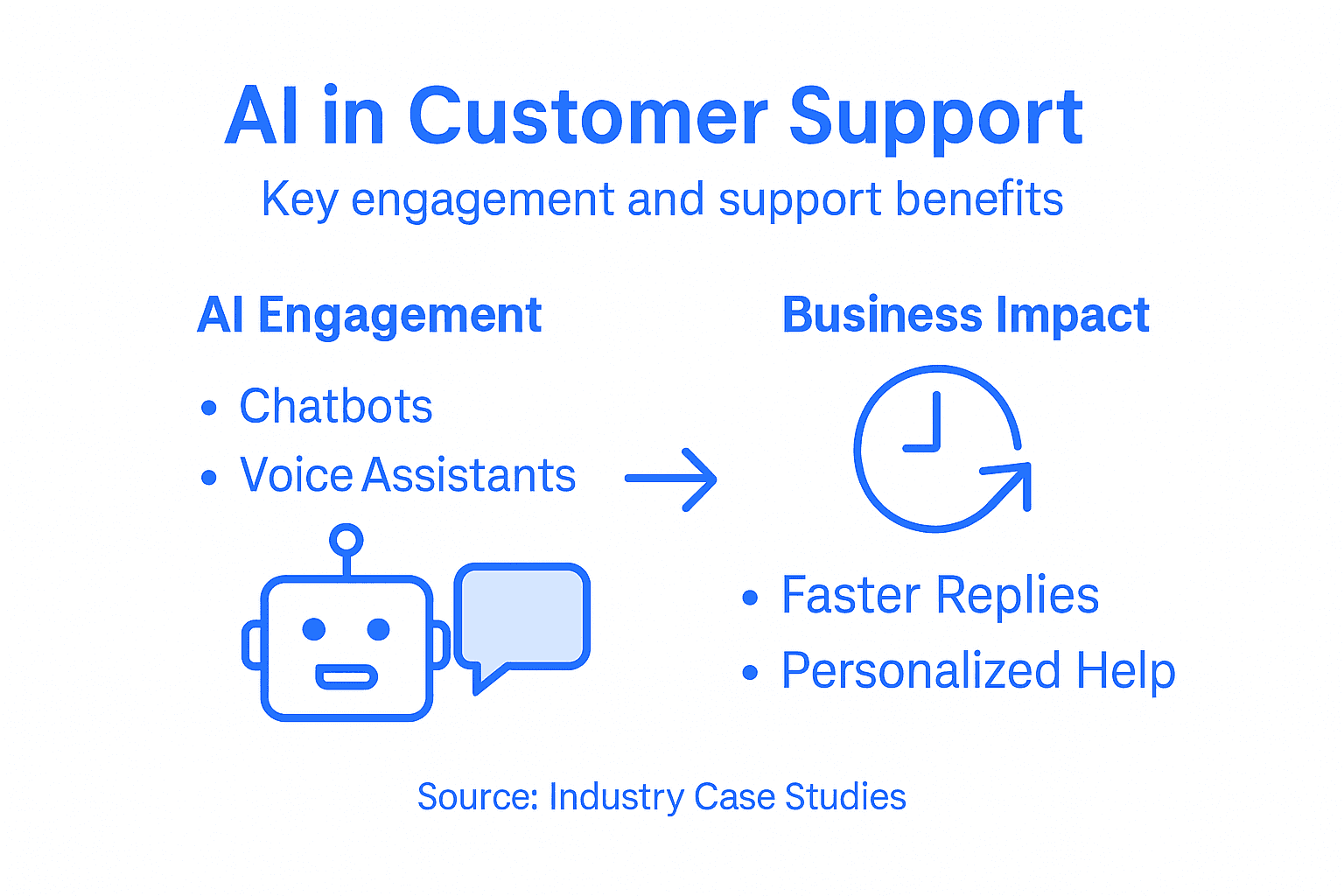
The primary categories of AI engagement include rule-based chatbots, AI-powered conversational agents, and advanced hybrid support systems. Rule-based chatbots operate using predefined scripts and decision trees, providing straightforward answers to common queries. In contrast, AI-powered conversational agents leverage natural language processing and machine learning to understand context, sentiment, and complex user intents. Hybrid support models represent the most sophisticated approach, seamlessly blending AI capabilities with human expertise to handle increasingly nuanced customer interactions.
Beyond traditional text-based interactions, AI engagement now spans multiple channels including voice assistants, social media support platforms, and integrated customer relationship management systems. These technologies can analyze customer data in real-time, predict potential issues, and proactively offer personalized solutions. The most advanced systems can even adapt their communication style based on individual customer preferences, creating more empathetic and responsive support experiences.
Here’s a quick comparison of the primary AI engagement technologies and their business advantages:
| AI Engagement Type | Core Technology Used | Main Business Benefit |
|---|---|---|
| Rule-based Chatbots | Decision trees, scripts | Handles common queries quickly |
| AI-powered Conversational | Machine learning, NLP | Adapts to complex questions |
| Hybrid Support Systems | AI plus human expertise | Balances efficiency and nuance |
| Voice Assistants | Speech recognition, AI | Enables hands-free interactions |
Pro tip: Implement a phased AI engagement strategy by first identifying repetitive customer support tasks that can be automated, then gradually introduce more complex AI interactions to build organizational confidence and customer trust.
How AI Chatbots Enhance Customer Support
AI chatbots have revolutionized customer support by dramatically improving response times and service quality. Generative AI conversational tools have demonstrated remarkable potential in transforming how businesses interact with customers, increasing agent productivity and enhancing overall support experiences.

The core strengths of AI chatbots lie in their ability to provide instant, round-the-clock support across multiple communication channels. AI-powered support systems excel at handling routine inquiries efficiently, allowing human agents to focus on more complex customer needs. These intelligent systems utilize advanced natural language processing to understand customer intent, provide personalized responses, and seamlessly route more challenging issues to human representatives when necessary.
Beyond simple query resolution, AI chatbots offer significant strategic advantages for businesses. They can analyze customer interaction patterns, provide real-time insights into customer preferences, and continuously improve their response accuracy through machine learning algorithms. The technology enables businesses to scale their support operations without proportionally increasing staffing costs, while simultaneously improving customer satisfaction through faster, more consistent service delivery.
Pro tip: Implement a gradual AI chatbot integration strategy by first mapping out your most common customer support queries and training your AI system on those specific scenarios to ensure high-accuracy initial interactions.
Real-World AI-Powered Engagement Use Cases
AI-powered engagement is transforming customer interactions across diverse industries, demonstrating remarkable versatility and impact. Global AI transformation stories reveal how organizations are leveraging intelligent technologies to revolutionize their customer support and engagement strategies.
In e-commerce, AI chatbots are streamlining customer experiences by providing instant product recommendations, processing returns, and answering complex shipping inquiries. Financial services firms use AI to detect potential fraud, offer personalized financial advice, and provide 24/7 account support. Healthcare organizations deploy AI-powered systems to schedule appointments, answer patient queries, and provide preliminary medical information while maintaining patient privacy and compliance with strict regulatory requirements.
Technology companies have been particularly innovative in implementing AI engagement strategies. Customer support departments are using advanced natural language processing to understand nuanced customer issues, route complex problems to specialized teams, and provide predictive solutions before customers even recognize a potential problem. Retail brands are utilizing AI to create personalized shopping experiences, offering real-time styling advice, size recommendations, and interactive product consultations that mimic in-store expert guidance.
Pro tip: Start your AI engagement implementation by mapping your most frequent customer interactions and selecting use cases with clear, measurable metrics to demonstrate immediate value and build organizational confidence.
Cost Savings and ROI of AI-Driven Tools
Businesses are increasingly recognizing AI-driven tools as strategic investments with substantial financial benefits. Customer service AI economics reveal remarkable potential for cost reduction and operational efficiency, demonstrating that intelligent technologies are not just technological upgrades but critical financial strategies.
The financial advantages of AI tools extend far beyond simple cost cutting. Typical implementations show significant improvements in productivity, with AI systems reducing customer support operational expenses by up to 68%. These tools enable businesses to handle exponentially more customer interactions without proportionally increasing staffing costs. Small and medium-sized businesses particularly benefit, as AI technologies provide enterprise-level support capabilities at a fraction of traditional infrastructure expenses.
Breakdown of AI-driven tool financial benefits typically include reduced labor costs, decreased response times, improved first-contact resolution rates, and enhanced customer satisfaction metrics. By automating routine inquiries, businesses can redirect human agents toward complex problem-solving and high-value customer interactions. The scalability of AI tools means companies can maintain consistent service quality during peak periods without massive workforce expansion, creating a flexible and cost-effective support infrastructure.
To better understand financial impacts, see this breakdown of typical AI-driven support cost savings:
| Savings Category | Description | Example Impact |
|---|---|---|
| Labor Cost Reduction | Fewer agents needed for routine tasks | Up to 68% savings |
| Faster Response Times | Instant answers reduce customer wait | Higher customer satisfaction |
| Scalability | Support more customers without hiring surge | Stable expenses during peaks |
| Improved Resolution Accuracy | AI learns and adapts for fewer errors | Less follow-up required |
Pro tip: Calculate your potential AI tool ROI by tracking current support costs, measuring average handling times, and projecting savings from automation before full implementation.
Common Pitfalls in Implementing AI Engagement
Implementing AI engagement technologies presents complex challenges that extend beyond technical implementation. Strategic AI deployment challenges reveal significant organizational and psychological barriers that can undermine successful adoption.
Organizations frequently encounter multiple critical implementation obstacles. Data quality represents the most fundamental challenge, with many businesses struggling to provide accurate, comprehensive training datasets for AI systems. Insufficient or biased data can lead to unreliable AI interactions, potentially damaging customer trust. Ethical considerations also emerge prominently, particularly around privacy, transparency, and the potential for algorithmic bias. Companies must carefully design AI systems that respect customer autonomy while delivering personalized experiences.
Technological integration challenges further complicate AI engagement strategies. Legacy systems often create compatibility issues, requiring substantial infrastructure redesign. Customer relationship management integration demands sophisticated technical expertise to ensure seamless communication between AI tools and existing customer support platforms. Human resistance represents another significant barrier, with employees frequently perceiving AI as a potential threat to job security rather than a collaborative tool that can enhance their professional capabilities.
Pro tip: Conduct comprehensive organizational readiness assessments and create detailed change management strategies before implementing AI engagement technologies to address potential resistance and technical integration challenges.
Unlock the Power of AI to Transform Your Customer Support Today
The article highlights the critical challenges businesses face in delivering fast, personalized, and scalable customer engagement through AI-driven tools like chatbots and conversational agents. If your goal is to reduce response times, improve first-contact resolution, and enhance customer satisfaction without increasing operational costs, embracing a flexible AI-powered solution is essential. ChatPirate.io offers a proven SaaS platform that helps you build customizable chatbots capable of learning from your own website content and knowledge bases to provide accurate 24/7 support across popular website builders like WordPress, Shopify, Wix, and Webflow.
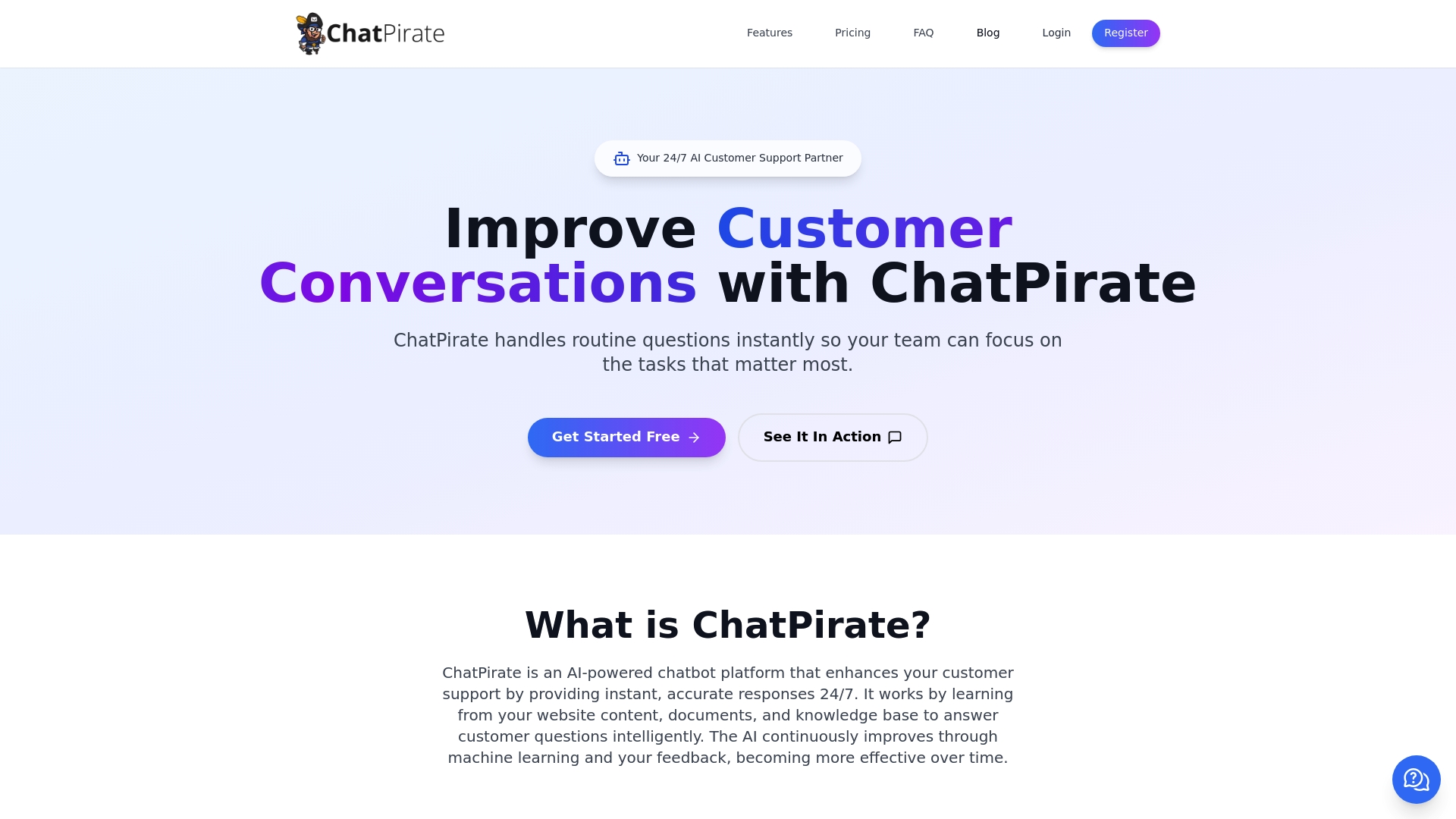
Experience how ChatPirate’s AI chatbots enable seamless human handoff, real-time analytics, and lead generation tools tailored to your industry needs. Don’t let the complexity of AI implementation slow you down. Start small, automate your most common queries first, and quickly scale your customer engagement with confidence. Visit ChatPirate.io to explore how easy it is to enhance your customer support with intelligent automation and drive measurable ROI today.
Frequently Asked Questions
What are the main benefits of using AI in customer engagement?
AI enhances customer engagement by providing hyper-personalized experiences, increasing response times, improving support quality, and enabling proactive customer service through predictive analytics.
How do AI chatbots improve customer support efficiency?
AI chatbots streamline support by offering instant, 24/7 responses to common queries, allowing human agents to focus on more complex issues, thereby increasing overall support efficiency.
What types of AI engagement technologies are available for businesses?
Businesses can utilize rule-based chatbots, AI-powered conversational agents, and hybrid support systems, each offering different levels of sophistication and benefits for customer interaction.
What common challenges do organizations face when implementing AI engagement?
Organizations often encounter obstacles such as data quality issues, technological integration with legacy systems, and resistance from employees who may fear job displacement due to AI adoption.