
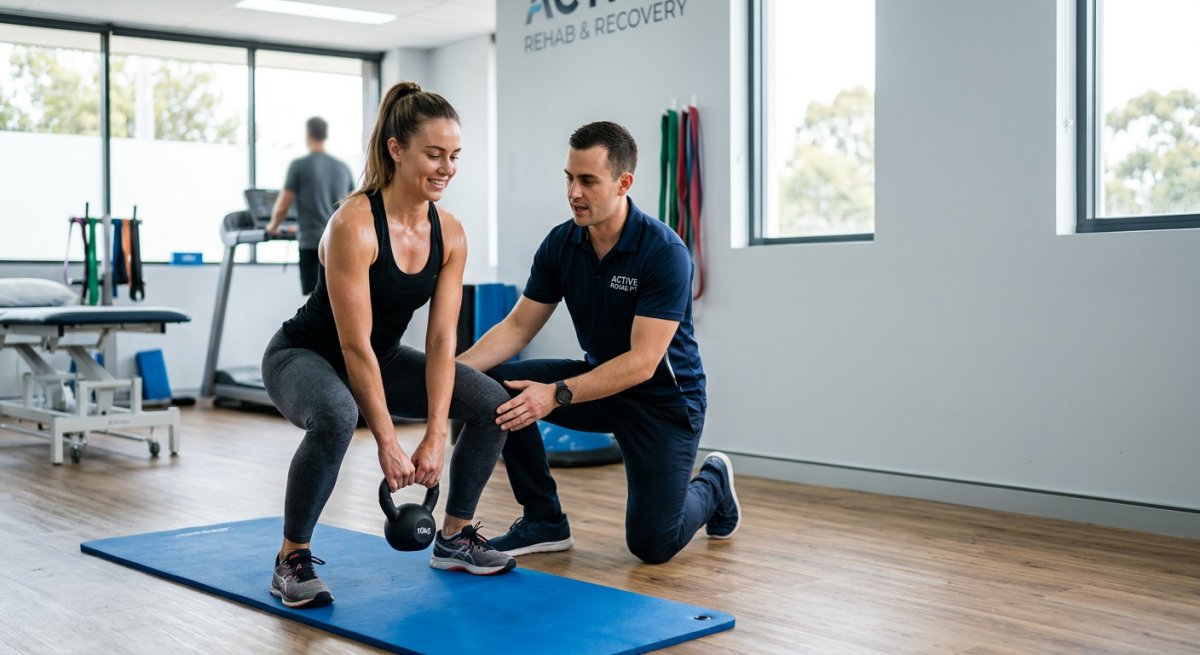
Complete Guide to Physical Therapy for Common Sports Injuries

More than 1 in 3 athletes suffer a sports injury each year. Missing practices and games hurts performance and careers. This guide shows how targeted physical therapy shortens recovery, lowers surgery risk, and gets athletes back to play with measurable milestones.
Table of Contents
- Defining Sports Physical Therapy
- How Physical Therapy Accelerates Recovery
- Common Sports Injuries and Tailored PT Plans
- Prevention: Functional Movement Assessment and Athlete Screening
- Telehealth, In-Clinic, and Hybrid Care Models
- Safe Return-to-Play: Protocols, Criteria, and Monitoring
Key Takeaways
| Point | Details |
|---|---|
| What sports PT includes | Assessment, manual therapy, progressive loading, neuromuscular re-education, education, and return-to-play planning. |
| Recovery timelines | Mild ankle sprain: 2-6 weeks; ACL reconstruction: 6-12 months; timelines depend on injury severity and sport. |
| Objective metrics | Clinicians use ROM, strength percentage vs contralateral limb, hop tests, and pain scores to track progress. |
| Prevention ROI | Functional screening reduces missed practices and lowers long-term injury risk, improving performance. |
| Care models | In-clinic hands-on care is essential for many injuries; telehealth and hybrid care increase access and adherence. |
Defining Sports Physical Therapy
Sports physical therapy is a specialized branch of physical therapy focused on preventing, assessing, and rehabilitating athletic injuries. It combines hands-on techniques, exercise prescription, education, and return-to-play planning to restore function and performance. The scope includes initial assessment, manual therapy, targeted strengthening, neuromuscular training, and sport-specific conditioning.
Sports physical therapy reduces recovery time and lowers the risk of chronic issues by applying progressive loading and movement retraining. Data shows physical therapy reduces the need for surgery by up to 50% when applied early and appropriately. Demand for sports PT is growing as athletes seek personalized plans and measurable outcomes.
Practitioners use validated tools and metrics to set expectations and measure progress. Examples include range of motion (ROM) measures, strength testing against the contralateral limb, single-leg hop tests, and patient-reported outcome measures for pain and function. These tools make recovery objective and predictable.
Start assessment within 72 hours of most non-life-threatening injuries to optimize conservative treatment, reduce inflammation, and set measurable short-term goals.
How Physical Therapy Accelerates Recovery
Physical therapy accelerates recovery by managing load and progressively reintroducing stress to tissues. Early interventions focus on pain control, swelling reduction, and restoring basic mobility. As symptoms improve, clinicians move to progressive loading to rebuild strength and tolerance.
Neuromuscular re-education and movement retraining restore proper movement patterns, reducing compensations that cause secondary injuries. Pain science education helps athletes engage with rehab confidently, lowering fear and improving adherence. We set clear objective milestones like strength symmetry and hop test scores to measure readiness.
Typical phased timelines give athletes realistic expectations. Examples: mild ankle sprain – 2 to 6 weeks, moderate rotator cuff strain – 6 to 12 weeks, ACL reconstruction – 6 to 12 months. Clinicians use metrics such as ROM targets, ≥90% strength symmetry, and hop test results to clear stages.
Use objective measures each week – ROM in degrees, strength as % of contralateral limb, and a timed hop test – to track progress and adjust load precisely.
Common Sports Injuries and Tailored PT Plans
ACL injury: Mechanism often involves pivoting or sudden deceleration. Red flags include instability and inability to bear weight. Assessment focuses on ROM, quadriceps activation, graft integrity post-op, and hop testing. Early goals emphasize full passive-extension, quadriceps activation, and progressive strength; expect a 6-12 month RTP timeline after reconstruction.
Ankle sprain: Lateral ankle sprain typically results from inversion. Red flags include persistent instability or peroneal tendon issues. Assessment measures proprioception, single-leg balance, and talocrural ROM. Rehab emphasizes early range, proprioceptive drills, and progressive plyometrics; mild sprains resolve in 2-6 weeks with guided rehab.
Rotator cuff strain: Mechanism includes throwing or overhead overload. Red flags are night pain, weakness, or loss of active elevation. Assessment includes scapular control, rotator cuff strength, and kinetic chain screening. Rehab focuses on scapular stabilization, rotator cuff eccentric loading, and sport-specific throwing progression; expect 6-12 weeks for strains, longer for tears.
Tailor exercises to sport and position – a lineman needs different hip strength and endurance than a sprinter; document sport-specific drills and test them before full RTP.
Prevention: Functional Movement Assessment and Athlete Screening
Prevention is a core value in modern sports PT. Functional movement assessments identify deficits before they cause injury. Common tools include the Functional Movement Screen (FMS), single-leg squat, hop tests, and objective strength testing. These assessments map risk and guide corrective programs.
Sample findings: diminished hip control on single-leg squat indicates weak gluteus medius; corrective strategies include glute activation, side-lying clams, and progressive lateral band walks. Another example: asymmetry on hop testing suggests a strength imbalance; a focused eccentric and plyometric program corrects that imbalance over 6-8 weeks.
The ROI is measurable: fewer missed practices, reduced re-injury rates, and improved long-term performance. Teams see reductions in soft-tissue injuries when they adopt targeted prevention protocols with 2-3 sessions per week of corrective work.
Implement a 10-15 minute pre-practice injury prevention routine based on screening findings; track compliance and re-test every 6-8 weeks.
Telehealth, In-Clinic, and Hybrid Care Models
Telehealth provides early access, exercise supervision, education, and progress checks. It is ideal for early post-injury consults, exercise progression, and post-op wound checks when hands-on care is not required. Telehealth improves adherence because athletes complete sessions on their schedule, and remote monitoring increases weekly touchpoints.
In-clinic care provides hands-on manual therapy, graded exposure, instrument-assisted soft tissue mobilization, and supervised high-load exercises. Many injuries require in-person sessions for manual techniques and objective testing. Hybrid models combine the strengths of both: in-clinic evaluations with telehealth follow-ups for exercise progression and accountability.
Telehealth use is growing rapidly and patients report high satisfaction with convenience and access. We integrate telehealth to increase session frequency without increasing travel, and we switch to in-clinic when hands-on or objective strength testing is required.
Use hybrid care for busy athletes – schedule weeks with one in-clinic session and two telehealth check-ins to maintain progress and reduce travel time.
Safe Return-to-Play: Protocols, Criteria, and Monitoring
Return-to-play is a staged, objective process. Clinicians use criteria such as strength symmetry ≥90%, hop test symmetry, pain-free sport-specific drills, and psychological readiness scales. We progress athletes from controlled conditioning to non-contact practice, then full practice, and finally competition based on meeting criteria.
Sample progression: Phase 1 – conditioning and strength; Phase 2 – sport-specific drills at 50% speed; Phase 3 – non-contact practice at 75% speed; Phase 4 – full practice with monitoring; Phase 5 – competition. Each phase requires objective metrics and clinician sign-off before progression.
Monitoring includes regular reassessments, workload tracking with GPS or session RPE, and telehealth check-ins for symptom reporting. This structured approach reduces re-injury risk and improves long-term outcomes by ensuring readiness not just by feel, but by data.
Require at least two consecutive assessments meeting objective RTP metrics before moving an athlete to full contact practice.
Comparison of Care Models
| Approach | Typical Use Case | Impact on Recovery |
|---|---|---|
| In-Clinic Hands-On | Post-op rehab, manual therapy, high-load strength testing | Fastest strength gains, accurate hands-on assessment, reduces complications |
| Telehealth | Early consults, exercise progression, follow-ups | Increases access, improves adherence, reduces travel time |
| Hybrid Model | Combination of in-clinic evaluation and remote follow-ups | Balances hands-on care with convenience, maintains intensity |
| Home Exercise Program | Supplemental between supervised sessions | Increases total load and consistency, requires monitoring for compliance |
Real World Use Case
A high school soccer player sprains her ankle in game play. We assess her within 48 hours, start targeted proprioception and progressive loading, run weekly ROM and hop tests, and use one telehealth check per week. She returns to competition at 4 weeks with full clearance after meeting strength and hop symmetry goals.
Transform Your Recovery with Back in Motion Sports & Physical Therapy
We specialize in personalized sports physical therapy in Southwest Florida. We assess your injury, set objective milestones, and deliver a clear plan to restore performance. Our team integrates hands-on care, sport-specific conditioning, and telehealth follow-ups so you progress efficiently and safely.
Contact us today to schedule an evaluation or to learn about our hybrid care options. We provide measurable goals, weekly progress reports, and documented return-to-play criteria so athletes and coaches know exactly where they stand.
- Personalized plans tailored to sport, position, and performance goals
- Objective metrics and documented milestones for each phase of recovery
- Hybrid care that reduces travel and increases session frequency
Frequently Asked Questions
Q: How soon should I start physical therapy after a sports injury? A: Start within 48 to 72 hours for most non-emergency injuries to control swelling and establish a baseline. Early assessment reduces recovery time and lowers the chance of needing surgery by up to 50%.
Q: How many PT sessions will I need? A: Most acute injuries require 6 to 12 sessions over 4 to 12 weeks, depending on severity and goals. Complex or post-op cases like ACL reconstruction often need 6 to 12 months of progressive rehab.
Q: When is telehealth appropriate versus in-clinic care? A: Telehealth works for early consults, exercise progression, and education; in-clinic care is required for manual therapy, hands-on assessments, and high-load strength testing. We use hybrid plans to combine both.
Q: What objective criteria determine safe return-to-play? A: We require ≥90% strength symmetry, hop test symmetry, pain-free sport-specific drills, and measured psychological readiness. Meeting these criteria over two consecutive assessments clears most athletes for progression.
Q: Will PT prevent surgery? A: For many soft-tissue injuries, guided PT reduces surgical need by up to 50% when applied early and with progressive loading. Cases with structural failure still require surgical consultation and coordinated post-op rehab.