

Optimize Live Chat Experience for E-Commerce Success
Choosing the right live chat solution can feel overwhelming as you balance customer expectations and available resources. For many retail businesses, evaluating current support systems is the first step toward building a more responsive and effective online presence. By focusing on systematic resource assessment and integrating smart automation like AI-driven chat, you set the foundation for instant response automation and memorable customer experiences.
Table of Contents
- Step 1: Assess Current Live Chat Needs And Resources
- Step 2: Integrate AI Chatbot For Instant Response Automation
- Step 3: Customize Chatbot For Brand Alignment And Key Workflows
- Step 4: Enable Seamless Human Handoff For Complex Inquiries
- Step 5: Monitor Chat Analytics To Improve Engagement And Satisfaction
Quick Summary
| Key Insight | Explanation |
|---|---|
| 1. Conduct a thorough support audit | Assess your current support channels to identify gaps and opportunities for improvement. |
| 2. Implement an AI chatbot | Use an AI chatbot to automate responses, reducing workload and enhancing customer experience. |
| 3. Customize chatbot for brand voice | Define your brand’s personality for your chatbot to ensure a consistent customer experience. |
| 4. Establish human handoff protocols | Create clear escalation protocols for complex inquiries to maintain customer satisfaction. |
| 5. Monitor analytics for insights | Utilize chat analytics to track performance and improve customer engagement over time. |
Step 1: Assess current live chat needs and resources
Optimizing your e-commerce live chat experience starts with a thorough understanding of your current support infrastructure. This critical evaluation will help you identify gaps, opportunities, and the most appropriate solutions for your business.
Begin by conducting a comprehensive audit of your existing customer support channels. Analyze metrics like current response times, customer satisfaction ratings, support ticket volumes, and the types of inquiries your team handles most frequently. Systematic resource assessment helps businesses make informed decisions about AI and chat technologies.
Key areas to evaluate include:
- Current support team size and availability
- Average response times
- Customer satisfaction scores
- Volume of daily support interactions
- Complexity of typical customer questions
- Budget for support technology
- Technical infrastructure capabilities
Carefully map out your current support workflow to understand where AI-powered live chat could provide the most significant improvements. This might involve reducing response times, handling basic inquiries automatically, or providing 24/7 support beyond human agent availability.
Accurate resource assessment is the foundation of successful live chat implementation.
Pro tip: Create a detailed spreadsheet tracking all current support metrics to establish a baseline for measuring future improvements.
Step 2: Integrate AI chatbot for instant response automation
Implementing an AI chatbot can dramatically transform your e-commerce customer support strategy by providing instant, accurate responses around the clock. The goal is to create a seamless automated support system that enhances customer experience while reducing operational workload.

Effective AI chatbot integration requires a strategic approach. Automated response systems can significantly improve customer interaction efficiency by handling routine inquiries instantly. Start by mapping out your most common customer support questions and scenarios to design a responsive chatbot framework.
Key implementation steps include:
- Identify top 10-15 most frequent customer inquiries
- Select an AI chatbot platform with robust learning capabilities
- Train your chatbot using existing support ticket data
- Configure natural language processing settings
- Establish clear escalation paths to human agents
- Set up analytics to track chatbot performance
- Create conversation flows for different customer interaction types
Ensure your AI chatbot can handle complex interactions by implementing contextual understanding and dynamic response generation. This means the chatbot should not just provide generic answers but understand nuanced customer questions and deliver precise, helpful information.
Here’s an overview of how AI chatbots enhance different aspects of e-commerce customer support:
| Area Improved | Traditional Support | AI Chatbot-Enabled Support | Business Impact |
|---|---|---|---|
| Response Time | Several minutes to hours | Instantly or within seconds | Higher satisfaction, fewer drop-offs |
| Availability | Business hours only | 24/7 non-stop | Global service, more sales |
| Basic Inquiry Handling | Manual by human agent | Automated, high accuracy | Reduced agent workload |
| Support Scalability | Limited by team size | Virtually unlimited | Handles peak volumes easily |
| Cost Efficiency | High labor costs | Lower operational expenses | Enables budget reallocation |
An intelligent chatbot acts as your first line of customer support, handling inquiries with speed and accuracy.
Pro tip: Continuously monitor and retrain your AI chatbot using actual customer interaction data to improve its response accuracy and effectiveness.
Step 3: Customize chatbot for brand alignment and key workflows
Customizing your AI chatbot goes beyond basic functionality – it’s about creating a digital representative that truly embodies your brand’s unique personality and customer support strategy. Chatbot personality development requires a thoughtful approach that aligns technological capabilities with your brand’s core values and communication style.
Begin by defining your brand’s unique voice and communication parameters. This involves establishing specific linguistic guidelines that reflect your company’s tone, whether that’s professional and direct, friendly and conversational, or technically precise. Consider creating a comprehensive brand communication guide specifically for your chatbot that outlines:
- Preferred language and terminology
- Acceptable humor and personality traits
- Response length and complexity
- Emotional intelligence parameters
- Specific industry-specific communication nuances
- Handling of sensitive or complex inquiries
Implement workflow customization by mapping out typical customer interaction scenarios and designing conversation flows that address each potential customer journey. This means creating detailed response trees that anticipate different customer needs while maintaining a consistent brand voice.
Your chatbot should feel like an extension of your team, not a disconnected automated system.
Pro tip: Conduct regular user testing and gather feedback to continuously refine your chatbot’s personality and response accuracy.
Step 4: Enable seamless human handoff for complex inquiries
Creating a robust human handoff mechanism is crucial for maintaining customer satisfaction when AI chatbots encounter complex or nuanced situations beyond their current capabilities. Human-AI transition strategies require careful design to ensure smooth and transparent interactions.
Establish clear escalation protocols that define exactly when and how a chatbot should transfer a conversation to a human agent. This involves creating intelligent triggers based on conversation complexity, customer sentiment, and specific inquiry types. Your handoff mechanism should include:
- Contextual information transfer
- Minimal customer repetition
- Quick response time
- Transparent transition process
- Consistent communication style
- Comprehensive conversation history tracking
Implement intelligent routing systems that match customer inquiries with the most appropriate human agent based on expertise, current workload, and specific issue characteristics. This ensures that customers receive specialized support quickly and efficiently.
A well-designed handoff strategy transforms potential frustration into a positive customer experience.
Pro tip: Regularly audit and refine your handoff processes by collecting feedback from both customers and support agents to identify and eliminate potential friction points.
Step 5: Monitor chat analytics to improve engagement and satisfaction
Understanding and leveraging chat analytics is crucial for continuously enhancing your e-commerce customer support experience. Interaction satisfaction metrics provide deep insights into how your chatbot performs and where improvements can be made.
Develop a comprehensive analytics tracking framework that captures key performance indicators essential for measuring customer engagement. Focus on gathering data across multiple dimensions to build a holistic view of your chatbot’s effectiveness:
- Response time intervals
- Customer sentiment scores
- Conversation completion rates
- Escalation frequency
- User satisfaction ratings
- Average interaction duration
- Query resolution percentages
- Repeat interaction rates
Implement real-time monitoring dashboards that allow you to track performance metrics dynamically. These dashboards should provide visual representations of your chatbot’s performance, highlighting areas of strength and opportunities for refinement. Configure automated alerts that notify your team about significant shifts in customer interaction patterns or potential system issues.
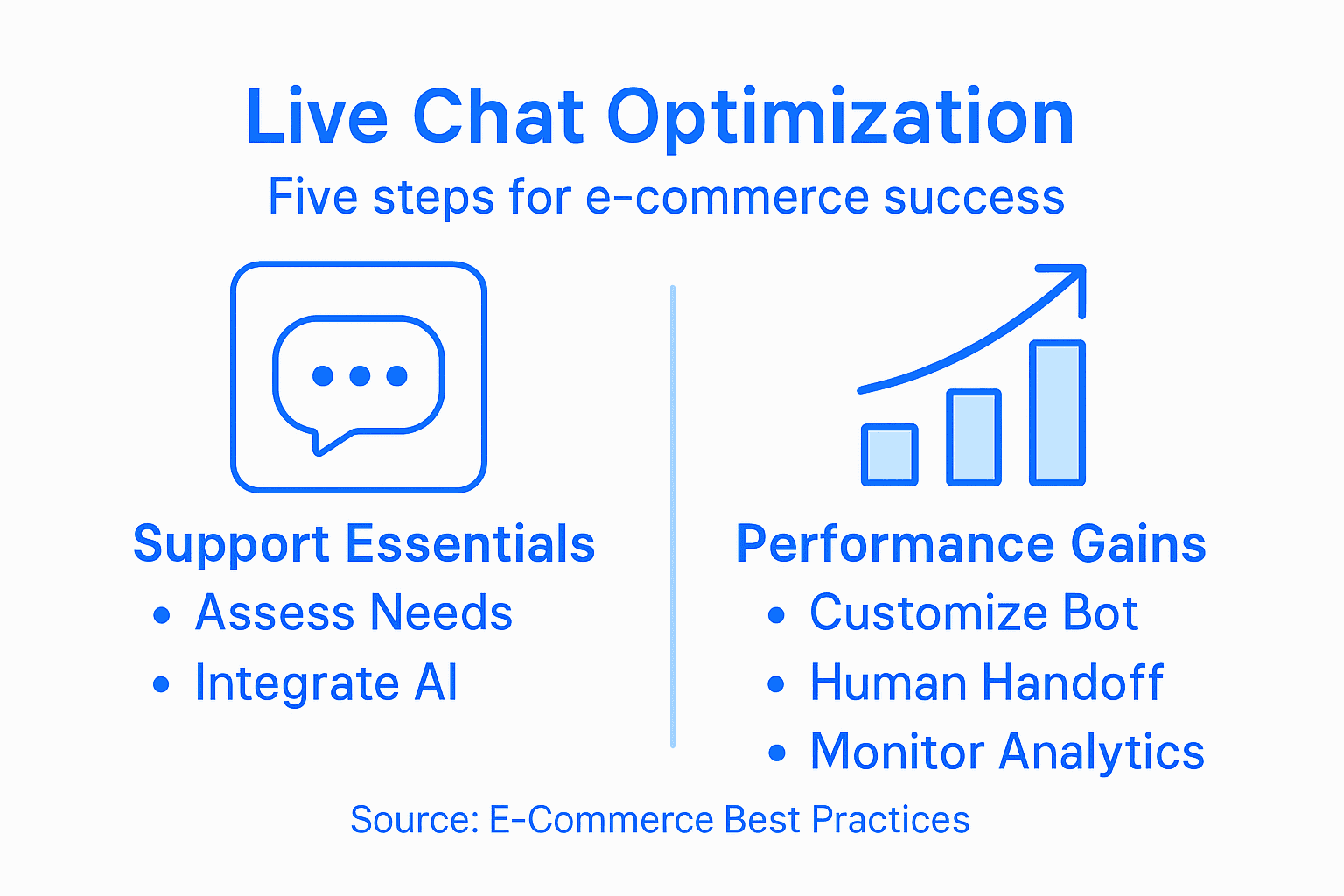
For quick reference, here are commonly tracked chat analytics metrics and their business value:
| Metric | What It Measures | Why It Matters |
|---|---|---|
| Response Time Interval | Speed of initial reply | Faster replies improve experience |
| Customer Sentiment | Positivity/negativity ratio | Guides tone and engagement |
| Escalation Frequency | Rate of human handoff | Reveals where chatbots need help |
| Conversation Completion | Finished chats vs abandoned | Indicates customer satisfaction |
| Query Resolution | Successful answers percentage | Shows chatbot effectiveness |
Continuous analytics monitoring transforms raw data into actionable customer experience insights.
Pro tip: Schedule monthly deep-dive analytics reviews to identify emerging trends and proactively adjust your chatbot’s conversational strategies.
Transform Your E-Commerce Live Chat with AI-Powered Solutions
Struggling to reduce long response times and improve customer satisfaction in your e-commerce live chat? The article highlights key challenges like the need for instant responses, seamless human handoff, and continuous optimization through data analytics. At ChatPirate.io, we understand the pain points of balancing quick support with personalized interactions. Our AI-powered chatbots are designed to automate common inquiries while maintaining your unique brand voice, ensuring customers get accurate answers 24/7 without feeling like they’re talking to a machine.
Take control of your customer experience now by deploying customizable chatbots that integrate effortlessly with top website builders such as Shopify and WordPress. Empower your support team with seamless escalation workflows and gain valuable insights from powerful analytics dashboards. Visit ChatPirate.io to start optimizing your live chat experience today and watch your e-commerce success soar. Discover how to reduce costs, increase engagement, and keep your customers coming back by visiting ChatPirate.io.
Frequently Asked Questions
How can I assess my current live chat needs for e-commerce?
To assess your current live chat needs, conduct a comprehensive audit of your existing customer support channels. Analyze key metrics like response times, customer satisfaction scores, and support ticket volumes to identify areas for improvement and set a baseline for implementing changes.
What steps should I take to integrate an AI chatbot into my e-commerce live chat?
To integrate an AI chatbot effectively, start by identifying the top 10-15 most frequent customer inquiries to guide your chatbot framework. Train the chatbot using existing support ticket data and ensure it has clear escalation protocols for complex questions, aiming for a seamless customer experience.
How can I customize my AI chatbot to align with my brand’s voice?
Customize your AI chatbot by defining your brand’s unique voice and creating a communication guide that outlines preferred language and response style. Map typical customer interactions and develop conversation flows that reflect your brand’s personality to enhance user engagement.
What is the best way to implement a human handoff strategy in live chat?
Implement a human handoff strategy by establishing clear escalation protocols that define when a chatbot should transfer a conversation to a human agent. Ensure the transfer includes context and conversation history so the customer does not have to repeat information, improving overall customer satisfaction.
How can I use chat analytics to improve my e-commerce live chat?
Utilize chat analytics by developing a tracking framework that monitors key performance indicators like response times and customer sentiment scores. Set up real-time monitoring dashboards to analyze performance trends and make data-driven adjustments, which can enhance customer engagement within weeks.
Recommended
- Why Use Chatbots: Powering Ecommerce Results — ChatPirate
- Role of Chatbots in E-Commerce Success — ChatPirate
- Chatbot User Experience: Impact on E-commerce Success — ChatPirate
- Chatbot User Experience: Impact on E-commerce Success – ChatPirate CMS
- How to Optimize Checkout Flow for AI-Driven Results – BizDev Strategy