

Role of AI in Ecommerce – Driving Growth and Efficiency
Trying to keep up with customer inquiries around the clock can stretch any small team to its limit. As online shoppers demand faster answers and smoother service, AI is quietly becoming the engine driving modern e-commerce success. AI-powered chatbots now deliver 24/7 support and significant cost savings by automating responses to customer questions, letting your team focus on what requires real expertise and a personal touch.
Table of Contents
- What Is AI in Ecommerce Today
- Major AI Technologies Shaping Ecommerce
- How AI Chatbots Transform Customer Support
- Personalization and Automation for Online Retailers
- Risks, Costs, and Common Pitfalls to Avoid
Key Takeaways
| Point | Details |
|---|---|
| AI is Essential for Competitiveness | AI adoption is directly linked to improved revenue and customer satisfaction in eCommerce. Retailers must quickly implement AI solutions to remain competitive. |
| Focus on Customer Service First | Starting with AI chatbots for customer service delivers rapid ROI by automating responses and improving efficiency. This allows teams to concentrate on more complex inquiries. |
| Personalization Boosts Retention | Using AI for personalized recommendations significantly enhances customer experience and increases average order value. Retailers should automate these processes for greater success. |
| Beware of Risks and Costs | Understanding the potential pitfalls of AI implementation—such as data biases and insufficient monitoring—is crucial. A well-planned approach with oversight can mitigate these risks. |
What Is AI in Ecommerce Today
Artificial intelligence in ecommerce isn’t science fiction anymore. It’s the operational backbone of how modern online retailers compete, serve customers, and scale efficiently. Right now, AI automates customer service, logistics, and personalization across the industry in ways that would have seemed impossible five years ago. Leading retailers like Amazon, Apple, Shein, and IKEA deploy AI with varying strategies based on their business models, and the correlation between AI adoption and revenue is undeniable. This isn’t theoretical. It’s happening in real stores, right now, with measurable results.
Today’s AI in ecommerce operates across multiple overlapping functions. For small to medium-sized retailers like you, the most relevant applications include automating customer service interactions, optimizing digital marketing campaigns, and personalizing product recommendations. Text creation, SEO optimization, and digital marketing have become standard uses since 2018, with adoption accelerating significantly in recent years. AI also generates product content, creates images and videos, and powers intelligent search capabilities that customers increasingly expect. What matters most for your business is that these tools reduce manual workload while improving customer experience simultaneously.
One critical piece: modern AI systems in ecommerce work best when they’re trained on your specific data. A chatbot handling support inquiries needs access to your product catalog, shipping policies, and return procedures to deliver accurate answers. This is why conversational AI and its impact on customer support matters so much. The technology learns from your unique business context, not generic training data. Your competitors might have chatbots. But do they have chatbots that actually understand your inventory, pricing, and policies? That’s where the real competitive advantage lives.
The practical reality is this: AI adoption correlates directly with revenue performance in ecommerce. Retailers who have implemented AI solutions report faster response times, reduced support costs, and higher customer satisfaction. But the gap between early adopters and laggards is widening. The question isn’t whether to implement AI anymore. It’s how quickly you can get started without disrupting existing operations.
Here’s a comparison of key AI applications in ecommerce and their business impact:
| AI Application | Description | Example Business Impact | Scalability for SMBs |
|---|---|---|---|
| Chatbots | Automate customer support responses | Reduces labor, improves response time | Highly accessible |
| Recommender Systems | Suggest products based on user behavior | Boosts conversions, lifts order value | Available via cloud platforms |
| Predictive Analytics | Forecast demand, trends, and inventory | Optimizes stock, prevents overordering | Moderate, growing options |
| Dynamic Pricing | Adjust prices based on market conditions | Maximizes margins, responds to demand | Requires careful oversight |
Pro tip: Start with customer service automation first—it delivers the fastest ROI by reducing response times and cutting support labor costs, while your team learns how AI works in your specific business context before expanding to other functions.
Major AI Technologies Shaping Ecommerce
The AI tools powering ecommerce today aren’t mysterious black boxes. They’re practical technologies solving real problems you face every day. Machine learning, deep learning, and predictive analytics form the foundation of modern ecommerce operations, enabling everything from product recommendations to dynamic pricing. These technologies work together to learn patterns from your customer data, spot trends before they become obvious, and automate decisions that would otherwise consume hours of manual work. For small to medium-sized retailers, understanding these core technologies matters because they directly impact how you compete against larger players.
Let’s break down what’s actually happening behind the scenes. Recommender systems analyze customer behavior to suggest products people are likely to buy, increasing your average order value without additional marketing spend. Virtual customer assistants handle inquiries around the clock, something your support team simply cannot do manually. AI applications in customer service, personalization, and security have become standard across leading ecommerce operations, with logistics automation adding another layer of efficiency. Visual and audio search capabilities let customers find products by uploading images or speaking queries, which younger shoppers expect as standard. Risk management tools flag fraudulent transactions in milliseconds, protecting your revenue and customer data simultaneously. The practical result: you reduce operational friction while improving customer experience.

What makes this relevant to your business is adoption strategy diversity. Larger retailers have invested heavily in custom AI solutions, but cloud-based platforms now democratize access to these same capabilities for smaller operators. You don’t need a team of data scientists to implement working AI. Chatbots trained on your product data deliver immediate returns by reducing support tickets and handling routine questions. Dynamic pricing algorithms adjust your margins based on demand, competition, and inventory levels without manual intervention. Understanding how chatbots drive ecommerce success reveals why so many retailers start here first. The technology learns your business patterns, adapts to seasonal changes, and improves over time as it processes more interactions.
The key insight: AI technologies work best when integrated into existing workflows rather than replacing them entirely. Your team remains in control while automation handles repetitive tasks. This hybrid approach lets you scale customer service, optimize marketing spend, and improve inventory management without complete operational overhauls. The retailers winning right now are those treating AI as a tool to amplify human effort, not eliminate it.
Pro tip: Start by identifying your highest-volume, most repetitive task (usually customer support questions), then implement AI there first to prove ROI before expanding to pricing, marketing, or inventory functions.
How AI Chatbots Transform Customer Support
Your support team doesn’t sleep. Neither do your customers. The moment a question arrives at 2 AM on a Sunday, you face a choice: ignore it until Monday or deploy a tool that never stops working. AI chatbots provide 24/7 availability and cost savings by handling initial customer contact through your website, answering questions instantly while your team focuses on complex issues that actually require human judgment. This isn’t about replacing people. It’s about redirecting human effort toward customers who truly need it. For small to medium-sized retailers, this distinction matters enormously because your support team is already stretched thin.
Here’s what actually happens when a chatbot handles your customer interactions. A customer lands on your product page at 11 PM with questions about sizing, shipping time, or return policies. Instead of bouncing to a competitor, they get instant answers trained on your specific business rules and inventory. The chatbot learns from every interaction, improving its responses over time. When the conversation requires human touch, it seamlessly hands off to your team with full context already documented. The result: faster resolution times, fewer repetitive questions consuming your team’s attention, and significantly reduced support costs. Rapid response times and consistent service quality directly drive customer satisfaction and loyalty. Customers remember brands that solve problems quickly. They abandon those that make them wait.
The transformation goes deeper than just speed. Customer retention improves when support quality feels reliable and responsive. Chatbots ensure consistency because they follow the same protocols every time, eliminating the variation that happens when exhausted support staff handle their fiftieth question of the day. Your best customer service representative can’t match the consistency of an AI trained on your knowledge base. More importantly, chatbots surface patterns in customer questions that reveal product gaps, confusing descriptions, or shipping issues you didn’t know existed. You gain actionable intelligence while simultaneously reducing support load. That’s the multiplier effect: solve problems faster while identifying what needs fixing.
What makes this work for your business is implementation simplicity. Understanding what AI chatbots actually do removes the mystery around whether this technology fits your operation. Successful deployment starts with training your chatbot on your product catalog, shipping policies, and FAQs. Set clear boundaries for when it escalates to humans. Monitor performance weekly. Adjust based on actual customer feedback. The retailers seeing strongest results treat chatbot implementation as an ongoing process, not a one-time setup.
Pro tip: Log the top 20 customer questions your team receives this week, then use those as your chatbot training foundation—you’ll see ROI within 30 days because you’re automating what’s already consuming your time.
Personalization and Automation for Online Retailers
Every customer thinks they’re unique. They are. Yet most online retailers treat them like interchangeable transactions. When a shopper visits your store, they expect to see products relevant to their interests, not a generic homepage that looks identical for everyone. AI-driven personalization uses recommendation systems and predictive analytics to tailor the shopping experience based on individual behavior, purchase history, and browsing patterns. This isn’t magic. It’s data analysis at scale. A customer who browsed winter boots last month sees boot-related accessories first. Someone searching for organic skincare sees related products immediately. The result: higher conversion rates, larger average order values, and customers who feel understood rather than ignored.
Automation works hand in hand with personalization to make this possible at your scale. You cannot manually track thousands of customer preferences and adjust inventory accordingly. AI handles this automatically. Dynamic pricing algorithms adjust your margins based on demand, competitor pricing, and inventory levels without human intervention. Stock management becomes predictive instead of reactive. You know what customers will want before demand spikes. Personalized email campaigns trigger automatically based on customer behavior, not generic broadcast schedules. Machine learning and recommendation systems create individualized shopping experiences that make customers feel like your store was built specifically for them. Platforms like Amazon and Shopify prove this works at massive scale. Now smaller retailers can access the same capabilities through cloud-based tools.
What matters most for your bottom line is this: personalization drives retention while automation cuts costs. A customer who feels recognized is more likely to return. A system that handles routine decisions automatically means your team focuses on strategy instead of data entry. You reduce labor costs while improving the shopping experience simultaneously. That’s the growth multiplication most retailers miss. They think personalization and automation are nice-to-haves. Actually, they’re competitive necessities. Retailers who personalize see 15-30 percent higher revenue per visitor than those running generic experiences. Automating support with AI chatbots extends this principle to customer service, ensuring every interaction feels tailored rather than templated.
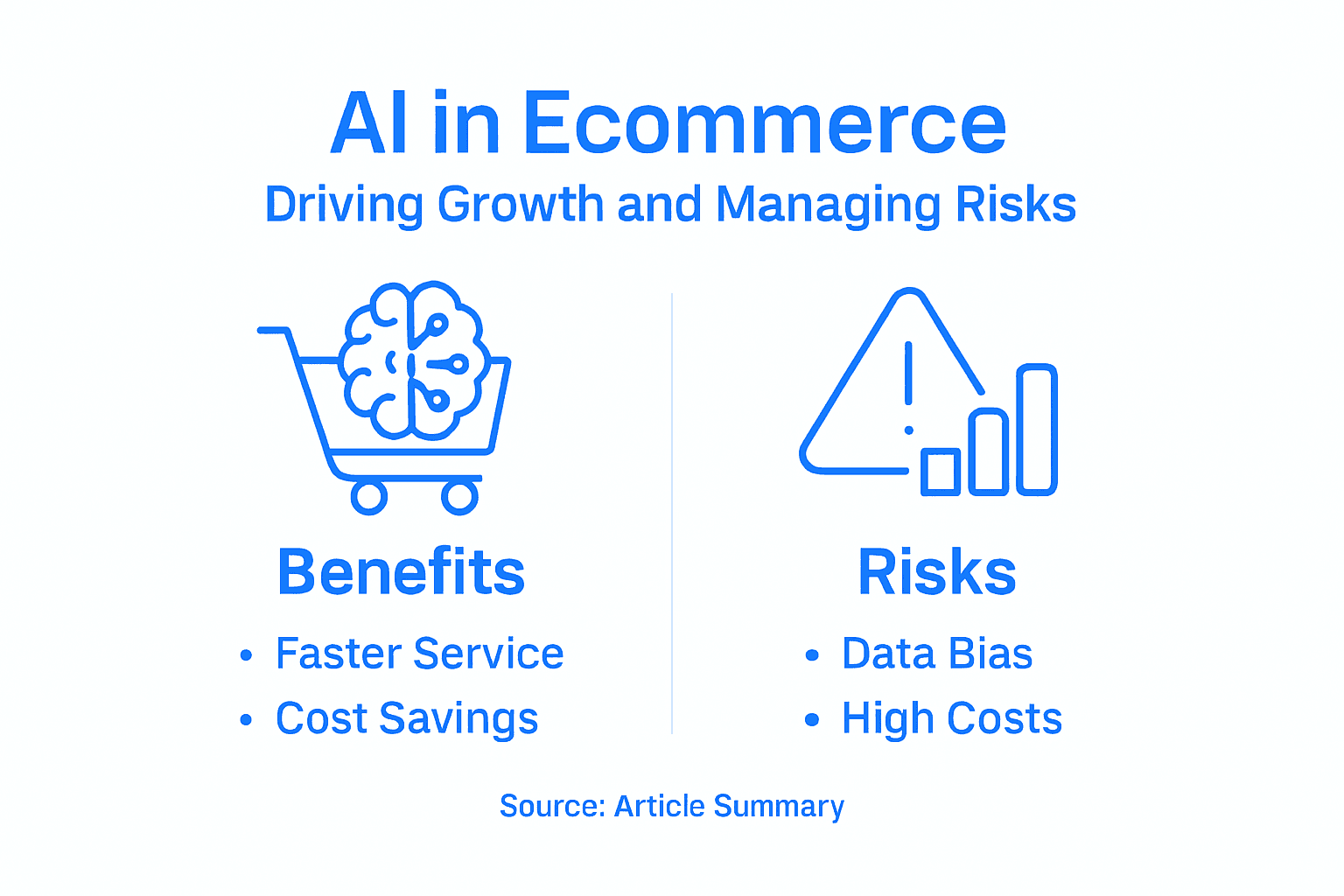
Implementation starts with your data. What information do you already have about customer behavior? Purchase history, browsing patterns, search queries, cart abandonment reasons. These data points become your personalization foundation. Start with product recommendations. Track performance metrics: conversion rate lift, average order value increase, repeat purchase rate. Automate based on quick wins first. As your team gets comfortable with automation, expand to pricing, inventory, and marketing. The retailers succeeding treat personalization as continuous improvement, not a one-time implementation.
Pro tip: Segment your customers into three groups: new visitors, repeat buyers, and at-risk customers, then create different automated experiences for each group rather than trying to personalize for everyone identically.
Risks, Costs, and Common Pitfalls to Avoid
AI sounds like a silver bullet until you realize it can fail spectacularly. A chatbot trained on biased data will make biased recommendations. A pricing algorithm that ignores competitor activity tanks your margins. An automated email campaign sent to the wrong audience damages brand trust permanently. Biases in training data and integration challenges represent real obstacles that trip up retailers who skip the planning phase. For small to medium-sized retailers, the stakes are higher because you have less margin for error. A bad AI implementation doesn’t just waste money. It erodes customer trust and damages your reputation in ways that take months to repair.
Let’s talk costs first because they surprise most retailers. Implementation sounds cheap until you add everything up. Software subscriptions, integration with existing systems, staff training, ongoing monitoring, and fixing problems when the AI makes mistakes. Many retailers underestimate the human oversight required. A chatbot still needs someone monitoring conversations to catch when it gives wrong information. Pricing algorithms still need humans checking if recommendations make business sense. If you deploy AI and assume it runs itself, you’ll discover the hard way that it doesn’t. The second pitfall is assuming one implementation solves all problems. Chatbots help with support volume. They don’t optimize your product descriptions or improve your supply chain. Each AI application requires separate consideration, budgeting, and management. Retailers who try solving everything simultaneously usually end up solving nothing well.
The ethical and operational risks deserve serious attention. Governance frameworks must address fairness, security, transparency, and privacy concerns to prevent reputational damage. A chatbot that discriminates against certain customer groups, even unintentionally, creates legal liability. A pricing algorithm that exploits vulnerable customers might be technically legal but morally indefensible. Data privacy matters enormously. If customers discover their personal information is being misused, they leave permanently. Cybersecurity threats targeting your AI systems put customer data at risk. These aren’t theoretical concerns. They’re real liabilities that grow as AI becomes more integrated into your operations.
Here’s what prevents these pitfalls. Start small with lower-risk applications. A chatbot handling FAQ questions carries less risk than an algorithm controlling your entire pricing structure. Test thoroughly before going live. Monitor performance constantly. Set clear escalation rules so humans intervene when the AI encounters situations it wasn’t trained for. Document your AI decision-making processes. Understand what data the AI uses and why. Be transparent with customers about where AI is involved. A customer knowing a recommendation comes from AI-analysis trusts it more than thinking they got a genuine personal suggestion from a human who didn’t actually review their account.
Here’s a summary of major risks and oversight requirements for successful AI adoption in ecommerce:
| Risk Type | Potential Consequence | Oversight Required | Mitigation Strategy |
|---|---|---|---|
| Data Bias | Biased recommendations | Regular data audits | Diverse, verified training data |
| Poor Integration | Operational errors, confusion | System compatibility checks | Step-by-step phased integration |
| Insufficient Monitoring | Unnoticed AI mistakes | Continuous human review | Clear escalation protocols |
| Privacy Concerns | Loss of customer trust | Compliance with regulations | Transparent data use disclosures |
Pro tip: Before implementing any AI system, establish success metrics and failure thresholds upfront—if chatbot accuracy drops below 85 percent or response times exceed 10 seconds, revert to human-only handling while you debug, rather than letting bad AI run continuously.
Elevate Your Ecommerce Customer Support with AI Chatbots Today
The article highlights how AI chatbots revolutionize ecommerce by delivering instant, accurate, and 24/7 customer service that reduces response times and support costs while improving satisfaction. If your small or medium-sized ecommerce business faces challenges with repetitive customer questions, slow response times, or inconsistent support quality, AI chatbots are the practical solution to automate these tasks without losing the human touch. Harnessing conversational AI that learns from your unique product catalog and policies is key to standing out amid fierce competition.
Experience the power of customizable AI chatbots designed for ecommerce businesses on ChatPirate.io. Our platform allows you to deploy intelligent chatbots quickly through easy integrations with WordPress, Shopify, Wix, and Webflow. With features like seamless human handoff, real-time analytics dashboards, and brand customization, you can streamline customer support, boost engagement, and scale efficiently all at once. Discover how automating your most repetitive tasks can free your team to focus on what truly matters and make your customers feel valued every hour of the day. Get started now with ChatPirate.io and see immediate improvements in support speed and customer satisfaction.
Unlock your business’s growth potential by combining personalization and automation powered by AI. Learn more about how AI chatbots transform ecommerce success and start building your tailored chatbot today.
Frequently Asked Questions
What are the main applications of AI in ecommerce?
AI applications in ecommerce include automating customer service, optimizing digital marketing campaigns, personalizing product recommendations, and managing logistics. These applications help improve customer experience while reducing manual workloads.
How can AI chatbots enhance customer support?
AI chatbots provide 24/7 availability, ensuring instant responses to customer inquiries. They learn from interactions to improve their accuracy and can handle common questions, allowing human agents to focus on more complex issues.
What benefits does personalized shopping using AI provide to retailers?
AI-driven personalization enables retailers to recommend products based on individual customer behavior and preferences. This leads to higher conversion rates, increased average order value, and improved customer satisfaction as shoppers feel more understood.
What are the risks associated with AI adoption in ecommerce?
The risks include data bias leading to inaccurate recommendations, poor integration causing operational issues, insufficient monitoring that may overlook AI mistakes, and privacy concerns that could erode customer trust. Proper oversight and testing are essential to mitigate these risks.