

Website Chatbot Technology: Boosting Ecommerce Support
Every e-commerce manager knows the frustration of seeing customers leave simply because their questions go unanswered. Quick, accurate responses have become the gold standard for online shopping, but providing that level of customer service around the clock strains most support teams. By adopting AI-powered website chatbots, you gain a tool built to handle repetitive tasks, answer questions instantly, and keep your customers engaged—all while lowering your operational costs. This overview explores what website chatbot technology is, how it works, and why small to midsized stores across North America are making the switch.
Table of Contents
- Defining Website Chatbot Technology
- Core Types And Underlying Mechanisms
- Key Features For E-commerce Success
- Practical Use Cases In Online Retail
- Legal And Security Responsibilities
- Cost Implications And Common Pitfalls
Key Takeaways
| Point | Details |
|---|---|
| AI-powered chatbots are essential for e-commerce. | They provide instant responses, improving customer satisfaction and boosting conversion rates. |
| Integrate seamlessly with existing platforms. | Chatbots should link directly to your website and access real-time data for accurate answers. |
| Choose the right type of chatbot. | Balance cost and effectiveness by considering rule-based, AI-powered, or hybrid solutions based on your customer needs. |
| Ongoing monitoring and optimization are crucial. | Regularly update your chatbot to maintain accuracy and adapt to changing customer behaviors. |
Defining Website Chatbot Technology
Website chatbots are AI-powered software applications designed to have conversations with visitors directly on your website. At their core, these tools use natural language processing (NLP) to understand what customers type or say, then respond with relevant answers in real time. Unlike traditional support systems where customers wait for a human agent, chatbots deliver instant responses 24/7, which is exactly what your e-commerce customers expect. Think of them as a tireless team member who never needs a break, handles repetitive questions, and frees up your actual staff to focus on complex issues that require human judgment.
The beauty of chatbot technology lies in how it simulates natural conversation. When a customer lands on your product page and has a quick question about shipping costs or return policies, a chatbot jumps in immediately with an answer. The customer doesn’t need to hunt through FAQ pages or wait for business hours. This responsiveness directly impacts your bottom line because customers who get quick answers are more likely to complete their purchase. Research shows that AI-powered conversational agents have become essential tools across various sectors including e-commerce, automating routine tasks while keeping interactions feeling natural and human. The technology has evolved significantly with advances in artificial intelligence, making it practical even for small online retailers without large IT budgets.
For e-commerce businesses specifically, chatbots handle the bread-and-butter support questions: “Do you ship to my area?”, “What’s your return window?”, “Is this item in stock?”, “How do I track my order?” These repetitive inquiries consume enormous amounts of your team’s time. A properly configured chatbot answers them instantly, reduces support ticket volume by 30 to 50 percent, and lets your support staff tackle more complex customer problems. The technology works by learning from your website content and knowledge base, which means it understands your specific products, policies, and brand voice. When you set one up through integrations with platforms like Shopify or WordPress, the chatbot begins pulling information from your existing pages, documentation, and FAQs to provide accurate responses tailored to your business.
Pro tip: Start by identifying your top 10 most frequently asked customer questions, then ensure your chatbot has clear, accurate information about each one before you launch it live on your site.
Core Types and Underlying Mechanisms
Not all chatbots work the same way. The type you choose depends on what problems you’re trying to solve for your customers. There are fundamentally two approaches: rule-based chatbots and AI-based chatbots, each with different capabilities and costs. Rule-based chatbots follow predetermined decision trees, meaning they respond based on specific keywords or predefined paths you set up in advance. If a customer types “shipping,” the chatbot displays your shipping policy. If they type “returns,” it shows your return policy. This approach works perfectly for straightforward questions with simple answers. The downside is that they can’t handle unexpected questions or variations in how customers phrase things. If someone asks “Do you deliver to my area?” instead of “What’s your shipping policy?” the rule-based chatbot might not understand.
AI-powered chatbots take a completely different approach using machine learning and advanced natural language processing. These systems learn from conversations and can understand intent behind customer questions, even when phrased differently. They don’t rely on rigid decision trees but instead process language the way humans do. When you implement AI-based chatbot systems, they become increasingly effective over time as they encounter more customer interactions. They handle follow-up questions, context from previous messages, and can even escalate to human agents when they recognize something beyond their capability. For e-commerce businesses with diverse product lines and customer needs, AI-powered solutions typically deliver better results because customers interact with them more naturally.

There’s also a middle ground. Hybrid chatbots combine different mechanisms to get the best of both worlds: menu-based options for customers who prefer simple clicks, keyword recognition for straightforward inquiries, and AI power for complex conversations. Button-based chatbots guide customers through menus (“Select: Shipping, Returns, or Product Info”), which works well when you want to control the conversation flow. The reality is that most successful e-commerce chatbots use a hybrid approach. They start with structured menus to keep simple questions fast and efficient, then hand off to AI capabilities when conversations get more complex. This combination reduces both costs (you’re not using expensive AI for every single interaction) and friction (customers get instant answers for common questions).
Understanding these mechanisms matters because they directly affect your return on investment. A rule-based chatbot costs less to build but solves fewer problems. An AI-powered chatbot costs more upfront but handles 70 to 80 percent of inquiries without human help, dramatically reducing support costs. Your choice should depend on your current support volume, the complexity of customer questions you receive, and your budget.
Pro tip: Start with a hybrid chatbot that handles your top 5 most common questions with simple menu buttons, then gradually add AI capabilities as you see which questions customers ask most frequently.
Here’s a side-by-side look at chatbot types and their fit for e-commerce:
| Chatbot Type | Best For | Main Strength | Limitation |
|---|---|---|---|
| Rule-based | Simple FAQs | Low cost, easy setup | Misses complex intent |
| AI-powered | Diverse queries | Learns, handles variations | Higher initial cost |
| Hybrid | Growing stores | Balances cost and power | Needs ongoing tuning |
Key Features for E-commerce Success
Not every chatbot feature matters equally for your online store. Some capabilities directly boost revenue and customer satisfaction, while others are nice-to-have extras that drain your budget. When evaluating chatbots for your e-commerce business, focus on features that solve real problems your customers face right now. The most critical feature is seamless platform integration. Your chatbot needs to connect directly to your website builder (whether you use Shopify, WordPress, Wix, or Webflow) without requiring a developer to write custom code. It should also pull data from your product catalog, inventory system, and order history automatically. When a customer asks “Is this item back in stock?” the chatbot should access real-time inventory data and give an accurate answer instantly. This kind of real-time interaction capability transforms chatbots from simple FAQ tools into powerful sales and support assets.
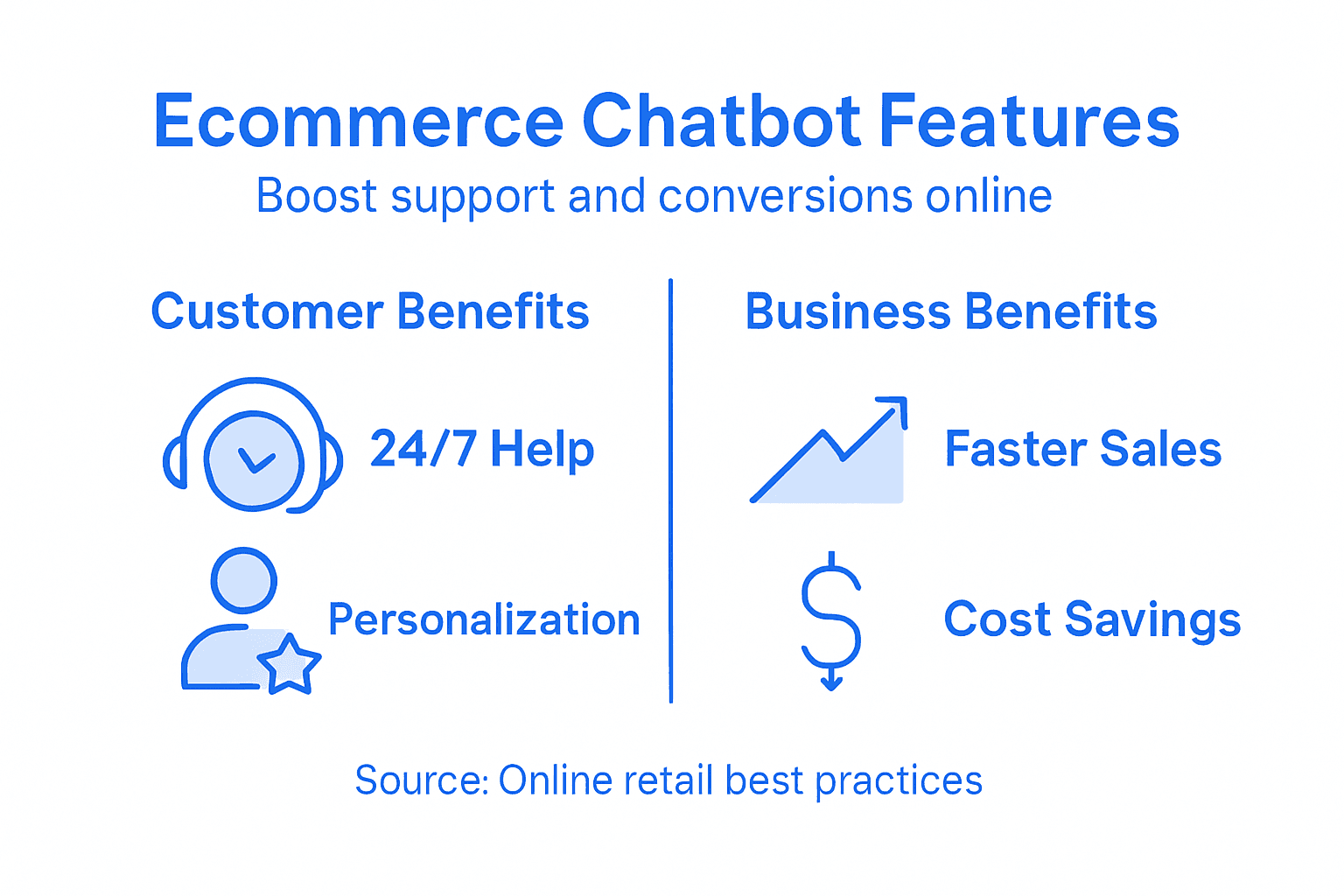
Personalization is your second must-have feature. A chatbot that remembers customer names, previous purchases, and browsing history creates the kind of tailored experience that makes customers feel valued. Instead of generic responses, your chatbot can say “Hi Sarah, I see you were looking at the blue sweater last week. We just got it back in your size.” This isn’t gimmicky—it drives conversions. Customers who receive personalized recommendations are 40 to 50 percent more likely to complete a purchase. Look for chatbots that use natural language processing to understand context and customer intent, not just keyword matching. When someone asks “Can I return this if I don’t like it?” the chatbot should understand they’re asking about your return policy, not testing your comprehension.
Another essential feature is human handoff capability. Your chatbot won’t solve every problem. Sometimes a customer has a genuinely complex question or a complaint that requires empathy and judgment. A quality chatbot recognizes its limitations and smoothly transfers the conversation to a human agent without forcing the customer to repeat themselves. The agent sees the full conversation history and can pick up exactly where the chatbot left off. This prevents the frustration customers feel when they retell their story to multiple people. Finally, prioritize analytics and reporting. You need to see which questions customers ask most, which issues your chatbot solves successfully, and where it falls short. This data tells you where to improve and proves the chatbot’s return on investment to your team.
Pro tip: Before selecting a chatbot platform, test it with your actual product catalog and ask it your 20 most common customer questions to ensure it answers them accurately before you go live.
Here is a quick overview of essential chatbot features and their direct impact:
| Feature | Purpose | Business Benefit |
|---|---|---|
| Platform Integration | Links product and order data | Enables accurate, real-time answers |
| Personalization | Uses customer history | Increases conversions, loyalty |
| Human Handoff | Transfers complex issues | Reduces customer frustration |
| Analytics | Tracks interactions | Guides future chatbot improvements |
Practical Use Cases in Online Retail
Chatbots shine brightest when they solve actual problems your customers encounter every day. For e-commerce businesses, the most impactful use cases focus on the moments that matter most in the buying journey. Product recommendations top the list. When a customer lands on your site unsure what to buy, a chatbot can ask a few quick questions (budget, size, color preference) and suggest relevant products within seconds. This works because customers who receive tailored recommendations spend 20 to 30 percent more per transaction. Your chatbot learns from your product catalog and can say “Based on the running shoes you viewed, you might also like our moisture-wicking socks” without any manual setup needed. This kind of personalized assistance drives both immediate sales and customer satisfaction.
Order tracking and status inquiries represent another gold mine for chatbot deployment. Customers obsess over their orders, especially during peak seasons. Instead of waiting for support staff to respond during business hours, chatbots answer instantly: “Your order ships tomorrow and arrives by Friday.” Even better, chatbots can manage order tracking across multiple platforms including your website, Facebook, and WhatsApp. Customers reach you wherever they prefer. When customers ask about returns, refunds, or exchanges, the chatbot retrieves their purchase history and gives context-specific answers. No more “Can you repeat your order number?”
Abandoned cart recovery is where chatbots prevent lost revenue. Every minute a customer abandons their cart represents money walking out the door. A chatbot sends a friendly message within minutes: “Hey, you left three items in your cart. Need help deciding? I can answer any questions about size, shipping, or our guarantee.” This simple intervention recovers 10 to 15 percent of abandoned carts, translating to thousands of dollars monthly for mid-sized retailers. The chatbot can also offer a small discount or highlight free shipping to push hesitant buyers across the finish line.
Don’t overlook basic FAQ automation either. Questions like “What’s your return policy?”, “Do you ship internationally?”, “How do I use a coupon code?”, and “What size should I order?” consume enormous amounts of support time. A chatbot answers these instantly and consistently, freeing your team to handle complaints and complex issues that actually need human judgment. The result is faster first response times, happier customers, and lower operational costs.
Pro tip: Start by identifying your top 15 customer support tickets from the last month, then map which ones your chatbot can handle immediately and which ones need human followup.
Legal and Security Responsibilities
Deploying a chatbot on your e-commerce site introduces legal obligations you cannot ignore. The moment your chatbot collects customer data, processes payments, or stores conversation history, you’re handling sensitive information protected by law. In North America, you must comply with regulations like the California Consumer Privacy Act (CCPA) and Canada’s Personal Information Protection and Electronic Documents Act (PIPEDA). These laws require you to disclose what data you collect, how you use it, and give customers the right to access or delete their information. If your chatbot collects email addresses, phone numbers, or browsing history without explicit consent, you’re violating these regulations. The penalties are substantial: fines up to $7,500 per violation under CCPA alone. More importantly, chatbot deployment raises immediate legal risks including data privacy and transparency concerns that evolving regulations like the EU AI Act are beginning to address. You need clear, accessible privacy policies explaining exactly what your chatbot does with customer information.
Security vulnerabilities pose equally serious risks. Chatbots are attack targets because they handle payment information, shipping addresses, and login credentials. A compromised chatbot can expose thousands of customer records in minutes. Security threats include malicious attacks, data breaches, and user profiling, requiring robust protections like encryption and authentication mechanisms. Your chatbot vendor should provide security certifications (ISO 27001 or SOC 2 compliance), encrypted data transmission, and regular security audits. Ask specifically how they protect data at rest and in transit. Don’t assume security is handled automatically. Verify that your chatbot platform uses industry-standard encryption, requires strong authentication for sensitive transactions, and has incident response procedures if a breach occurs. Your customers trust you with their information, and breach liability falls on you, not the platform provider.
Transparency and accuracy matter legally and ethically. Your chatbot must clearly identify itself as automated, not human. If customers believe they’re talking to a person when they’re actually talking to AI, you’ve created a trust violation that could trigger consumer protection violations. Make sure your chatbot doesn’t make false claims about products (like guaranteeing an item will fit when fit depends on individual body type) or misrepresent your policies. Document your chatbot’s limitations clearly. If your chatbot makes a mistake providing information, your business bears responsibility for that error, not the chatbot. Test thoroughly before launch and monitor for hallucinations or incorrect information your AI model might generate.
Pro tip: Before going live, have a lawyer review your chatbot’s privacy policy, data handling practices, and error scenarios to ensure compliance with CCPA, PIPEDA, and your state’s specific consumer protection laws.
Cost Implications and Common Pitfalls
Chatbot costs vary dramatically based on the solution you choose and how you implement it. A simple rule-based chatbot on a platform like Shopify costs between $20 and $100 monthly and handles basic FAQ responses. An AI-powered chatbot with natural language processing and machine learning capabilities typically runs $200 to $500 monthly, depending on conversation volume and customization. Enterprise solutions with advanced features and dedicated support exceed $1,000 monthly. But the real expenses extend beyond software licensing. You’ll invest time training the chatbot with your product data, setting up integrations with your inventory system, and monitoring performance. Many businesses underestimate these hidden costs and end up spending 2 to 3 times their initial budget before the chatbot delivers real value. The good news is that this investment pays back quickly through reduced support staff hours, increased conversion rates, and fewer abandoned carts.
The biggest pitfall? Deploying a chatbot without understanding its limitations. Businesses often assume chatbots can handle everything customer service representatives handle, then become frustrated when the chatbot fails. Common pitfalls include insufficient natural language understanding, poor platform integration, and lack of real-time responsiveness that directly reduce customer satisfaction. A chatbot that doesn’t understand variations in how customers phrase questions frustrates users and damages your brand reputation. A chatbot that takes 5 seconds to respond feels slow compared to human conversation. A chatbot that fails to integrate with your inventory system gives customers inaccurate stock information. These failures aren’t chatbot problems, they’re implementation problems. The solution is thorough testing before launch and iterative improvement based on actual customer interactions.
Another critical mistake is launching a chatbot and ignoring it. AI models degrade over time as customer behavior changes and new products arrive. If your chatbot still recommends discontinued items or uses outdated policies, customers lose trust quickly. Challenges in implementation include high maintenance complexity and user resistance due to perceived impersonality, requiring strategic refinement and continuous monitoring. Plan for ongoing costs related to AI model updates, staff time reviewing chatbot conversations, and periodic retraining with new data. Most successful e-commerce businesses dedicate 2 to 3 hours weekly to chatbot optimization. They review conversation transcripts to identify questions the chatbot struggles with, update response training data, and refine escalation rules. This ongoing attention keeps the chatbot effective and prevents the common scenario where expensive tools become expensive neglected systems.
Pro tip: Calculate your current monthly support costs by multiplying average hourly rates by time spent on FAQ-style inquiries, then compare that to chatbot subscription costs to determine your breakeven point before investing.
Enhance Your Ecommerce Support with AI-Powered Chatbots
The article highlights the challenges ecommerce businesses face with repetitive customer questions, slow response times, and complex inquiries that consume support resources. If your store struggles with answering FAQs like shipping policies, order tracking, or abandoned cart recovery efficiently your goal should be to provide instant personalized assistance while reducing operational costs. By harnessing key chatbot features such as seamless platform integration, AI-based natural language processing, and smooth human handoff you can transform your online customer experience and boost conversions.
ChatPirate.io offers an intuitive SaaS solution expressly built to solve these pain points. Our customizable chatbots learn directly from your website content and product catalog to provide accurate real-time answers any time of day year-round. With easy setup on platforms like Shopify and WordPress you can deploy your bot quickly without coding. Plus with advanced analytics dashboards and branding options ChatPirate empowers you to continuously optimize and align the chatbot with your unique business needs.
Take the next step to elevate your ecommerce support and increase sales today. Experience how AI-driven conversations reduce abandoned carts improve customer satisfaction and lighten your team’s workload. Seeing is believing so imagine your customers receiving instant personalized help right now Explore ChatPirate.io and start building your chatbot solution that scales as your business grows.
Discover how easy it is to integrate with your site
Learn more about AI chatbot benefits
Get started with ChatPirate now
Frequently Asked Questions
What are website chatbots?
Website chatbots are AI-powered software applications that engage with visitors on your site, using natural language processing (NLP) to understand and respond to customer queries in real time.
How do chatbots improve e-commerce customer support?
Chatbots provide instant responses to common customer questions 24/7, reducing the workload on human agents and improving customer satisfaction by offering quick solutions to inquiries about shipping, returns, and product availability.
What are the differences between rule-based and AI-powered chatbots?
Rule-based chatbots follow predetermined scripts and can only respond to specific keywords, while AI-powered chatbots utilize machine learning to understand a wider range of inquiries and improve over time through interaction.
What essential features should I look for in an e-commerce chatbot?
Look for features such as seamless platform integration for real-time data access, personalization capabilities for tailored customer experiences, human handoff options for complex queries, and analytics for monitoring performance and improving service.