

What Is Chatbot Analytics and How It Drives E-commerce
More than 60 percent of American e-commerce businesses are investing in chatbot technology to keep up with rising customer expectations. For store owners, understanding exactly how shoppers interact with virtual assistants can mean the difference between abandoned carts and record sales. Chatbot analytics uncovers the stories hidden in each conversation, offering practical insights to strengthen support and convert more visitors into loyal customers.
Table of Contents
- Defining Chatbot Analytics for E-commerce
- Types of Insights Chatbot Analytics Provides
- How Chatbot Analytics Tools Work
- Using Analytics to Improve Customer Support
- Common Pitfalls and Best Practices
Key Takeaways
| Point | Details |
|---|---|
| Insight on Customer Behavior | Chatbot analytics reveals deep insights into customer interactions, helping e-commerce businesses understand preferences and engagement patterns. |
| Improving Customer Support | By analyzing interaction data, businesses can refine chatbot responses and enhance overall customer support strategies. |
| Holistic Data Utilization | Combining quantitative data with qualitative insights ensures a deeper understanding of customer satisfaction and engagement quality. |
| Proactive Strategy Development | Regular reviews of chatbot analytics enable businesses to identify trends and optimize digital customer interactions effectively. |
Defining Chatbot Analytics for E-commerce
Chatbot analytics represents a sophisticated approach to understanding customer interactions through artificial intelligence powered conversational interfaces in e-commerce environments. This powerful analytical method goes beyond simple conversation tracking, offering deep insights into customer behavior, preferences, and engagement patterns. By leveraging advanced data processing techniques, businesses can transform raw chatbot interactions into strategic intelligence that drives sales and enhances customer experiences.
At its core, chatbot analytics involves analyzing conversational commerce interactions to extract meaningful patterns and insights. E-commerce businesses use these analytics to understand critical metrics like customer intent, product interest, support request frequencies, and conversion potential. The process involves examining multiple dimensions of chatbot interactions, including response times, query types, resolution rates, and customer satisfaction indicators.
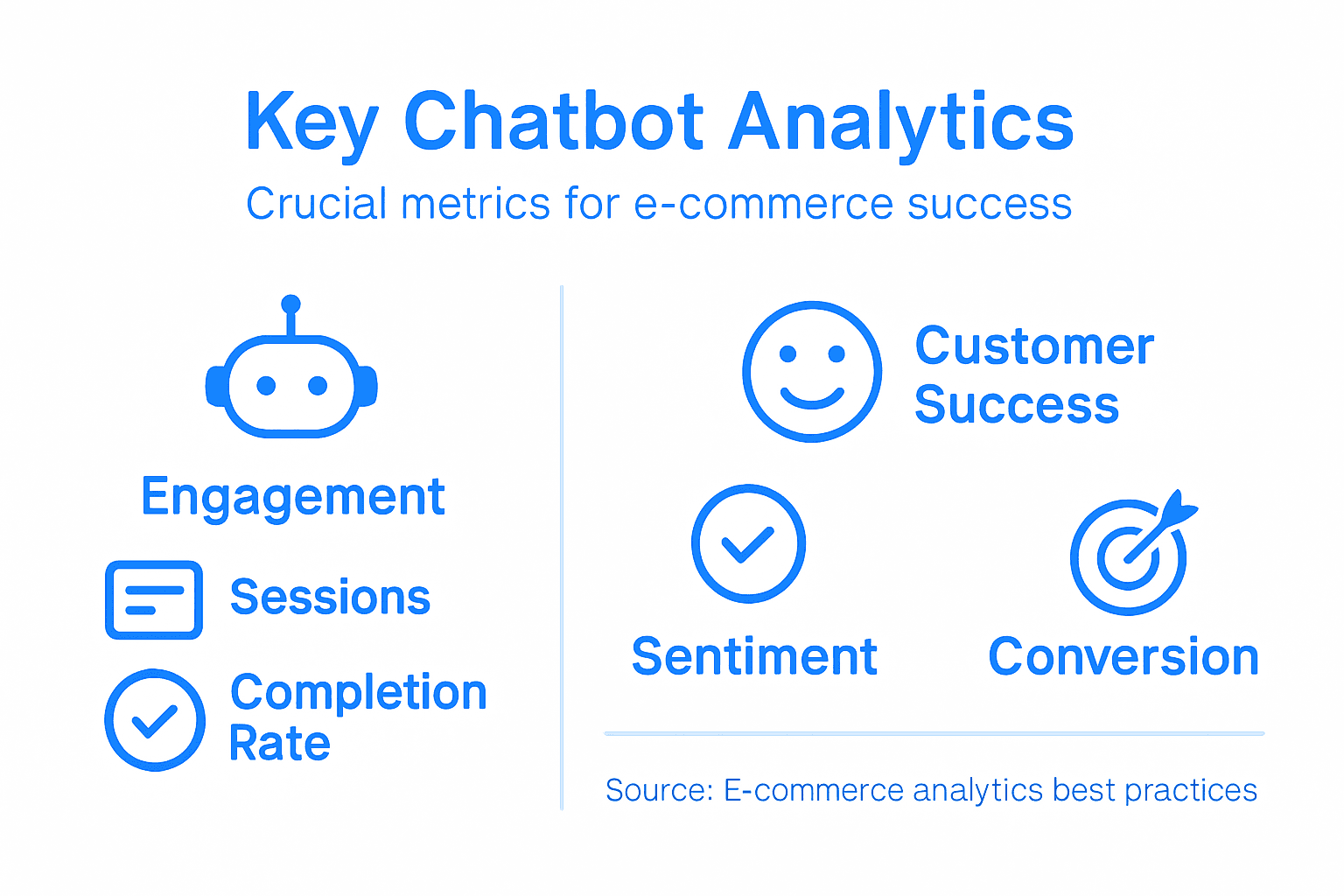
Key components of chatbot analytics for e-commerce include tracking metrics such as engagement rates, conversation completion percentages, user sentiment, and recommendation effectiveness. These analytics help businesses optimize their chatbot performance, personalize customer experiences, and identify potential areas of improvement in their digital customer support strategies. By understanding how customers interact with AI-powered conversational interfaces, companies can refine their approach to online customer engagement.
Here’s a summary comparing key chatbot analytics metrics and their impact on e-commerce outcomes:
| Metric | Business Impact | Typical Improvement Goal |
|---|---|---|
| Engagement Rate | Boosts customer interaction | Increase active user sessions |
| Conversation Completion | Reduces drop-offs | Raise conversation completion rate |
| Sentiment Tracking | Enhances service personalization | Improve positive sentiment scores |
| Recommendation Accuracy | Drives sales conversion | Elevate purchase recommendation wins |
Pro tip: Implement a systematic approach to reviewing your chatbot analytics dashboard weekly, focusing on trends and anomalies that could indicate emerging customer needs or potential technical improvements.
Types of Insights Chatbot Analytics Provides
Chatbot analytics delivers a comprehensive suite of insights that transform raw conversational data into strategic business intelligence for e-commerce platforms. By capturing and analyzing multiple dimensions of customer interactions, businesses can uncover nuanced understanding of user behavior, preferences, and engagement patterns. These insights go far beyond simple transaction tracking, offering a deep dive into the psychological and functional aspects of digital customer experiences.
One critical area of insight involves understanding customer trust and engagement through detailed interaction analysis. E-commerce businesses can now examine precise metrics such as conversation flow, response effectiveness, problem resolution rates, and emotional sentiment. These insights help organizations identify potential friction points in the customer journey, optimize chatbot performance, and develop more personalized engagement strategies.
The types of insights generated through chatbot analytics are multifaceted and include behavioral patterns, conversion potential, support efficiency, and user experience metrics. Key analytical areas encompass response time analysis, query categorization, user intent detection, recommendation accuracy, and satisfaction level tracking. By aggregating these granular data points, businesses can create more intelligent, responsive, and customer-centric conversational interfaces that adapt in real-time to user needs and preferences.
Pro tip: Configure your chatbot analytics dashboard to generate automated weekly reports highlighting key performance indicators, allowing your team to quickly identify trends and potential optimization opportunities.
How Chatbot Analytics Tools Work
Chatbot analytics tools represent sophisticated technological solutions that transform raw conversational data into actionable business intelligence. These advanced systems leverage complex algorithms and machine learning techniques to capture, process, and analyze every interaction between customers and digital chatbot interfaces. By breaking down each conversation into granular components, these tools provide e-commerce businesses with unprecedented insights into customer behavior and interaction patterns.

Modern analytics frameworks utilize natural language processing to interpret user intents, sentiment, and engagement levels with remarkable precision. The core functionality involves collecting multiple data points during each interaction, including response times, query types, resolution rates, and emotional context. Advanced tools go beyond simple metric tracking, employing artificial intelligence to predict customer needs, optimize conversation flows, and identify potential areas for improvement in the customer support experience.
The technical architecture of chatbot analytics tools typically involves several interconnected components. These include data collection modules that capture conversation transcripts, natural language processing engines that interpret conversational context, machine learning algorithms that identify patterns and trends, and visualization dashboards that present complex insights in user-friendly formats. By integrating these components, businesses can gain a comprehensive understanding of their chatbot’s performance, customer satisfaction levels, and potential strategic opportunities for enhancing digital customer interactions.
Pro tip: Configure your chatbot analytics tool to generate automated segmentation reports that break down user interactions by demographic, behavioral, and contextual variables to uncover deeper customer insights.
Using Analytics to Improve Customer Support
Chatbot analytics has revolutionized customer support strategies by providing unprecedented visibility into customer interaction patterns, challenges, and satisfaction levels. E-commerce businesses can now leverage deep insights to transform their support infrastructure, moving from reactive problem-solving to proactive customer experience optimization. This data-driven approach enables companies to understand customer needs with remarkable precision, ultimately reducing response times and improving overall service quality.
Real-time data from chatbot interactions allows businesses to identify common customer inquiries, pain points, and communication bottlenecks. By analyzing conversation transcripts, support teams can systematically modify chatbot scripts, develop more intelligent response protocols, and create targeted training resources for human agents. The analytics provide granular insights into each stage of customer interaction, from initial query to final resolution, helping organizations continuously refine their support strategies.
The most advanced chatbot analytics tools offer comprehensive capabilities for improving customer support, including sentiment analysis, language style optimization, and intelligent routing mechanisms. These tools can detect emotional nuances in customer conversations, recommend personalized solutions, and seamlessly escalate complex issues to human representatives. By integrating machine learning algorithms, businesses can create adaptive support systems that learn and improve with each interaction, ultimately delivering more empathetic, efficient, and contextually relevant customer experiences.
Pro tip: Create a monthly review process that analyzes your chatbot analytics dashboard to identify emerging customer support trends and develop targeted improvement strategies.
Common Pitfalls and Best Practices
Implementing chatbot analytics requires a strategic approach that balances technological capabilities with human-centered design principles. E-commerce businesses must navigate a complex landscape of potential challenges while maintaining a clear focus on delivering exceptional customer experiences. Understanding the most common pitfalls and establishing robust best practices becomes crucial for organizations seeking to maximize the potential of their chatbot analytics infrastructure.
Quantitative metrics alone can mislead businesses about their true customer interaction quality. The most significant pitfall is over-relying on numerical data without considering the qualitative nuances of customer conversations. Successful implementations require a holistic approach that combines hard data with emotional intelligence, ensuring that chatbots can understand and respond to the subtle contextual signals present in customer interactions. This means going beyond simple response times and resolution rates to analyze the depth of customer engagement and satisfaction.
Effective chatbot analytics strategies demand continuous refinement and a commitment to adaptive learning. Best practices involve establishing comprehensive monitoring systems that track not just conversation outcomes, but the entire customer journey. This includes developing sophisticated error tracking mechanisms, creating flexible escalation protocols for complex queries, and maintaining a dynamic approach to chatbot training. Organizations must also prioritize seamless integration between AI-driven chatbot systems and human support teams, ensuring that technological solutions complement rather than replace human expertise.
The following table highlights common pitfalls in chatbot analytics and recommended best practices for mitigation:
| Challenge | Risk | Recommended Practice |
|---|---|---|
| Over-reliance on quantitative data | Misjudging customer satisfaction | Review qualitative conversation samples |
| Lack of regular performance audits | Missed opportunities for improvement | Set quarterly deep-dive audits |
| Poor escalation for complex queries | Customer frustration, unresolved issues | Develop dynamic escalation protocols |
| Insufficient AI-human integration | Disjointed support experiences | Promote seamless team coordination |
Pro tip: Conduct quarterly comprehensive audits of your chatbot analytics, comparing quantitative metrics with randomly sampled conversation transcripts to ensure your AI’s performance aligns with genuine customer experience goals.
Unlock the Power of Chatbot Analytics to Transform Your E-commerce Support
Understanding detailed customer interactions through chatbot analytics is essential for any e-commerce business aiming to improve engagement and increase sales. This article highlights the challenges of leveraging raw conversational data to gain meaningful insights like sentiment tracking and conversation completion rates. At ChatPirate.io, we address these challenges by offering AI-powered chatbots that are easy to integrate and come equipped with advanced analytics dashboards to help you see exactly how customers interact in real time.
Take control of your customer support by deploying customizable chatbots that learn from your knowledge bases and continuously refine their responses. Visit ChatPirate.io now to discover how our platform can reduce operational costs, increase support speed, and improve customer satisfaction. Start turning your chatbot analytics into actionable strategies that drive growth today.
Frequently Asked Questions
What is chatbot analytics in e-commerce?
Chatbot analytics refers to the analysis of customer interactions with AI-powered conversational interfaces in e-commerce. It helps businesses understand customer behavior, preferences, and engagement patterns by examining metrics such as response times, resolution rates, and customer satisfaction indicators.
How can chatbot analytics improve customer support?
By analyzing chatbot interactions, businesses can identify common customer inquiries and pain points, which allows them to modify chatbot scripts and optimize response protocols. This data-driven approach enhances service quality and enables proactive customer experience optimization.
What key metrics should businesses track in chatbot analytics?
Key metrics include engagement rates, conversation completion percentages, user sentiment, and recommendation effectiveness. Tracking these metrics helps businesses optimize chatbot performance and personalize customer experiences.
What are common pitfalls when implementing chatbot analytics?
Common pitfalls include over-relying on quantitative data without considering qualitative insights, lack of regular performance audits, poor escalation protocols for complex queries, and insufficient integration between AI chatbots and human support teams.