

What Is Chatbot Training Data: Boosting AI Support
Every e-commerce manager knows the frustration of answering the same customer questions day after day. When customer support demands grow, finding smarter ways to automate responses becomes critical. High-quality diverse datasets form the backbone of any effective chatbot, helping artificial intelligence understand real conversations and provide accurate answers. This overview separates common myths from practical strategies, showing how thoughtful data selection can turn your chatbot into a true extension of your business knowledge.
Table of Contents
- Chatbot Training Data Defined and Debunked
- Types and Sources of Training Data for Chatbots
- How Quality Impacts Chatbot Performance
- Best Practices for Data Selection and Preparation
- Risks, Privacy Concerns, and Compliance Requirements
Key Takeaways
| Point | Details |
|---|---|
| Importance of Quality Data | High-quality, diverse training data significantly enhances chatbot performance over sheer volume. |
| Continuous Data Update | Regularly update training data to reflect evolving business practices and customer inquiries. |
| Data Organization | Organize training data into clear categories to improve chatbot understanding and response accuracy. |
| Compliance and Privacy | Ensure compliance with privacy regulations by anonymizing sensitive customer data in training sets. |
Chatbot Training Data Defined and Debunked
Let’s cut through the noise. Chatbot training data is simply the collection of text, conversations, and information that an AI chatbot learns from to understand and respond to customer questions. Think of it like teaching someone a new job. You wouldn’t just hand them a single manual and expect them to handle every customer situation perfectly. Instead, you’d expose them to dozens of real conversations, edge cases, and examples until they develop the judgment to respond correctly on their own. That’s exactly how chatbots work. The data teaches them patterns, context, and how to match customer questions to appropriate answers.
Here’s what often gets misunderstood. Many business owners assume that more training data automatically equals better chatbot performance. That’s partly true, but it’s incomplete. Research shows that high-quality diverse datasets are what actually matter for developing accurate and contextually relevant responses, not simply volume. A chatbot trained on 50 poorly organized support tickets might perform worse than one trained on 10 carefully curated conversations that cover the real issues your customers actually face. Quality beats quantity. Additionally, adversarial inputs and weak safeguards within training data can cause rapid performance degradation, which is why careful curation matters far more than many people realize. This is the difference between a chatbot that confidently gives wrong answers and one that actually helps your customers.
For e-commerce managers specifically, your training data typically includes your product descriptions, FAQ documents, shipping policies, return procedures, and previous customer service conversations. When you set up a chatbot on ChatPirate, you’re essentially feeding it your business knowledge base so it can answer questions like “Can I return this within 30 days?” or “What’s the shipping cost to California?” without human intervention. The stronger and more organized this data is, the fewer wrong answers your customers receive. This directly impacts your support costs. A well-trained chatbot handles 60 to 70 percent of routine inquiries completely on its own, which means your team spends time on complex issues instead of answering the same questions repeatedly.
One more critical point: training data isn’t static. As your business grows and customer questions evolve, your chatbot needs updated information. If you launched a new product line six months ago but never updated your training data, your chatbot is still operating with incomplete knowledge. The best performing chatbots are ones where companies continuously refine their training data based on what customers actually ask, not what the manager thinks they’ll ask.
Pro tip: Start your chatbot training with your top 20 customer service questions and your complete product documentation, then let it run for two weeks while monitoring which questions it handles poorly—these gaps show you exactly where to expand your training data next.
Types and Sources of Training Data for Chatbots
Training data comes in different flavors, and knowing which type you need depends entirely on what your chatbot is supposed to do. The most common categories include task-oriented data, natural language conversation data, and domain-specific information. Task-oriented data teaches your chatbot to complete specific actions like processing returns or looking up order status. Natural language data shows the chatbot how people actually talk, with all their typos, casual phrasing, and unexpected questions. Domain-specific data is your proprietary stuff: your product catalog, policies, and past customer conversations that make your chatbot uniquely yours. These three work together. A chatbot trained only on generic conversation data but lacking your specific product knowledge will sound natural but give wrong answers. One trained only on your policies without understanding natural language patterns will sound robotic and miss what customers actually mean.

Where does this data come from? For e-commerce businesses, your primary sources are usually internal. Your FAQ documents, product descriptions, customer service email threads, and chat histories from your existing support system all contain gold. You have thousands of real customer questions already answered correctly by your team. That’s incredibly valuable training material that your competitors don’t have access to. Beyond internal sources, there are publicly available datasets like WikiQA Corpus and question-answer databases that many chatbot builders use to give their models a foundation in general knowledge and conversation patterns. The best performing chatbots combine both: they start with a foundation of general knowledge from public datasets, then get fine tuned with your specific business data so they understand your products, policies, and tone of voice.
Here’s a comparison of common chatbot training data types and their unique business value:
| Data Type | Key Characteristics | Typical Source | Business Impact |
|---|---|---|---|
| Task-Oriented Data | Direct action/response patterns | Process docs, support replies | Enables automation of tasks |
| Natural Language Data | Real-world phrasing, typos | Live chats, emails | Improves conversational flow |
| Domain-Specific Data | Proprietary product info | Product catalogs, policies | Delivers accurate answers |
| Public Dataset Foundation | Generic Q&A, broad knowledge | WikiQA, question corpora | Boosts general understanding |
Here’s the practical reality for your situation. You probably don’t need to source data from Twitter conversations or academic question-answer corpora. Your sweet spot is creating a clean, organized collection of your best internal documentation and customer service interactions. This might mean exporting your last 2,000 support tickets, organizing your FAQ by category, creating clear question-answer pairs from your most common inquiries, and documenting edge cases your team handles frequently. The broader point is this: diverse data spanning structured knowledge bases and question-answer pairs gives your chatbot comprehensive understanding of both your business and how humans communicate. A chatbot trained on “How do I track my order?” and “Where’s my package?” and “Can you tell me when my shipment arrives?” learns that these three questions mean the same thing. That’s the power of data diversity.
One mistake we see repeatedly is treating old, outdated information as training data. If your FAQs haven’t been updated in three years but your shipping partners changed, your return policy shifted, or you discontinued products, that old data actively hurts your chatbot. It’s worse than missing data because it confidently gives wrong information. Your training data should reflect your current business state, not your state from two years ago when you first wrote those support documents.
Pro tip: Audit your existing support tickets from the past six months and pull out the top 30 questions by frequency, then format these as clean question-answer pairs to use as your core training dataset—this focused approach delivers better results than uploading every ticket you have.
How Quality Impacts Chatbot Performance
Here’s the hard truth: a chatbot is only as smart as the data feeding it. When you invest time into cleaning, organizing, and curating your training data, every single customer interaction improves. When you skip this step and dump messy, outdated information into your system, you get predictable results: confused responses, frustrated customers, and a support tool that actually creates more work than it solves. The relationship between data quality and chatbot performance isn’t subtle. It’s direct and measurable. Poor data quality leads to misinformation spread and degrades the entire human-computer interaction, which is why businesses that take data seriously see dramatically better outcomes than those that don’t.
Let’s talk specifics. When your training data is high-quality, your chatbot gets better at three things simultaneously. First, accuracy improves because the chatbot learns from correct examples of how to answer your specific customer questions. A chatbot trained on five variations of “How long does shipping take to Texas?” with five correctly formatted answers will recognize when a customer asks “What’s the delivery timeline for my order to TX?” and respond appropriately. Second, efficiency increases because your team wastes less time correcting wrong answers. A chatbot that confidently tells customers they have 90 days to return items when your policy is 30 days creates angry customers and loads your support team with complaints. Third, user satisfaction climbs because customers actually get the information they need on the first try. This is where the business case gets compelling. Companies report that high-quality chatbot training data correlates directly with improved user experience and operational efficiency. Fewer escalations to human agents means lower support costs. Faster resolutions mean happier customers. Accurate answers mean fewer returns and chargebacks from confusion.
Now consider the opposite scenario. Imagine you exported your last three years of support tickets into your chatbot without any cleanup. You’ve got outdated pricing, discontinued products, old process flows, and customer service reps having bad days and giving inconsistent answers. Your chatbot absorbs all of that. It learns bad patterns. It picks up on contradictions. When one ticket says returns are free and another says there’s a 15-dollar restocking fee, the chatbot gets confused about what’s true. This isn’t a minor problem. This is the difference between a chatbot that serves your business and one that sabotages it. The solution is continuous improvement. Quality isn’t a one-time setup. As your business evolves, your training data needs to evolve with it. When you update your return policy, update your chatbot’s knowledge. When you launch a new product, add examples of how customers ask about it. When you notice the chatbot giving wrong answers about a specific topic, that’s your signal to audit and improve the training data in that area.
For e-commerce managers, this means treating your chatbot’s training data like you treat your inventory management. You don’t just throw inventory in your warehouse and hope it works. You organize it, track it, update it, and remove what’s obsolete. Your chatbot data deserves the same discipline. The payoff is real: better customer experiences, lower support costs, and a tool that actually reduces your team’s burden instead of adding to it.
To help maximize chatbot performance, here is a concise summary of key training data quality concerns and their real-world consequences:
| Data Issue | Typical Cause | Negative Outcome | Remedy |
|---|---|---|---|
| Outdated Information | Old tickets, old FAQs | Delivers wrong answers | Regular data reviews |
| Low Data Quality | Poorly formatted examples | Confused chatbot responses | Careful filtering & cleaning |
| Data Overload | Too much irrelevant material | Slower chatbot training | Curate for relevance |
| Unstructured Data | No clear categories | Missed links between topics | Organize by topic |
Pro tip: Set a monthly review cycle where you pull your chatbot’s lowest confidence responses and chat logs showing customer confusion, then use these as signals to identify exactly which training data sections need updating or expansion.
Best Practices for Data Selection and Preparation
Selecting the right training data is half the battle. The other half is preparing it so your chatbot actually learns from it instead of getting confused. Start by thinking about your end goal. What questions do you want your chatbot to answer? For an e-commerce store, that might be shipping timelines, return policies, product specifications, and order tracking. Your data selection should directly align with those goals. If you select training data about billing disputes but your chatbot never needs to handle billing questions, you’ve wasted resources on irrelevant information. The first practical step is to audit what data you actually have access to. Pull your FAQ documents, your last six months of support tickets, your product catalog, your shipping policy documents, and any other customer-facing information your team maintains. This becomes your raw material.
Next comes the hard part: cleaning and filtering. Not all your data is equally valuable. Data filtering removes low-quality, biased, or irrelevant content to maximize training efficiency, which directly impacts how well your chatbot performs. Look through your support tickets and remove ones where the answer was wrong, incomplete, or where the customer service rep was having a bad day and gave inconsistent information. Remove outdated information. If you have 200 tickets about a discontinued product, those don’t help your chatbot answer current customer questions. Remove duplicates. If you have 50 variations of “How do I track my order?” with the same answer, keep maybe 5 or 6 strong examples instead. This filtering phase actually makes your training data stronger, not smaller. A chatbot trained on 100 excellent, focused examples outperforms one trained on 1,000 mediocre, noisy examples.
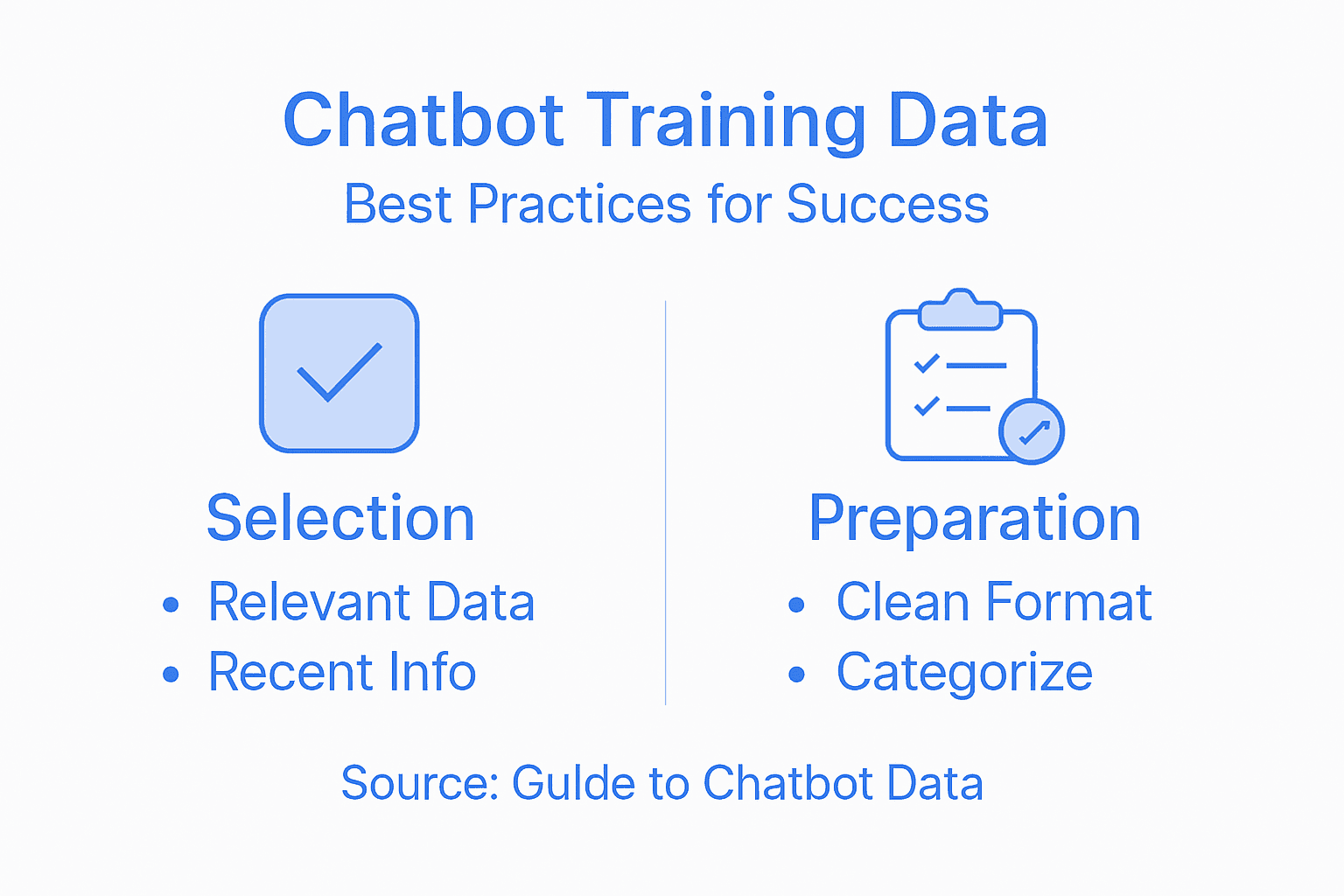
Organization matters more than you might think. Structure your data clearly by category. Create a system where each question-answer pair is labeled by topic: shipping, returns, products, billing, account management. This helps your chatbot understand relationships between questions. It also helps you spot gaps. If you have 80 examples about shipping but only 3 about returns, you know where to invest more effort in data preparation. When preparing data, aim for diversity. Natural language nuances and multilingual requirements need careful consideration when assembling training datasets. A customer might ask “How do I track my order?” or “Where’s my package?” or “Can you tell me when this arrives?” Include all these variations so your chatbot learns that different phrasings mean the same thing. If you operate in multiple countries or serve bilingual customers, make sure your training data reflects that.
One final consideration that many businesses overlook: version control your training data. Keep a record of what you fed your chatbot and when. This seems administrative, but it’s incredibly valuable. When your chatbot starts giving wrong answers, you can trace back to what changed in your training data. Maybe you updated your return policy last month but forgot to update the chatbot’s knowledge. When you notice a problem, you have a clear record of your training data versions to help identify what went wrong. This is exactly how ChatPirate users implement continuous improvement. They upload their initial training data, monitor performance for two weeks, identify gaps from customer interactions, update the training data, and repeat. This cycle compounds over time, creating a chatbot that keeps getting smarter.
Pro tip: Create a simple spreadsheet documenting your training data sources with columns for topic, number of examples, last updated date, and known gaps, then review it monthly to identify which areas need expansion based on actual customer questions you’re seeing.
Risks, Privacy Concerns, and Compliance Requirements
Your chatbot handles customer data. That alone means you need to think seriously about privacy and compliance before you deploy it. When you feed customer conversations, order histories, and support tickets into your chatbot’s training data, you’re creating a system that processes sensitive information. If you’re not careful about what data goes in and how it’s protected, you could expose yourself to legal liability, regulatory fines, and damaged customer trust. The risks are real, especially for e-commerce businesses operating across multiple regions with different data protection laws. European customers fall under GDPR. Canadian customers have PIPEDA requirements. Many states now have their own privacy laws. This isn’t abstract legal stuff. This directly affects how you can prepare and use your training data.
Start with what data you’re actually including in your training data. Customer email addresses, phone numbers, order details, payment information, and any personally identifiable information should be removed or anonymized before you use support tickets for training. A support ticket that says “Customer Jane Smith at jane.smith@email.com returned order 45892 because the product arrived damaged” contains three pieces of PII that need to be stripped out. You want the training data to be “Customer returned order because product arrived damaged,” which teaches your chatbot the right behavior without exposing customer privacy. Beyond privacy, there’s the risk of training your chatbot on data that contains misinformation, privacy violations, and regulatory challenges. If your support team inadvertently gave customers wrong information and you train your chatbot on those tickets, you’ve now automated the delivery of misinformation. This is why the data cleaning phase is so critical.
Here’s where many businesses get tripped up: they assume that because they own the customer data, they can use it however they want. Not true. You can only use customer data for the purposes you disclosed when collecting it. If your privacy policy says you collect customer information to process orders and provide support, you can’t suddenly feed that data into a chatbot training system without updating your privacy policy. Customers need to know what you’re doing with their information. Some industries have additional requirements. If you operate in healthcare, education, or handle financial information, your compliance obligations are more stringent. You might need explicit consent to use customer data for training purposes. ChatPirate and similar platforms should provide clear documentation about how they handle your training data, where it’s stored, and whether it’s ever used to improve the platform generally (which would be another privacy consideration).
The compliance piece also involves disclosure of AI chatbot use, particularly in sensitive contexts like health and wellness_762b6259-ca7f-422f-b705-3172f0006f40.pdf). Even for e-commerce, being transparent that customers are interacting with an AI chatbot rather than a human is important. If your chatbot makes a mistake that causes a customer loss, and they discover later that they were talking to an AI when they assumed they were talking to a support agent, that’s a problem. Many jurisdictions now require explicit disclosure when someone is interacting with an AI system. Make sure your chatbot clearly identifies itself as automated. Your terms of service should address what happens when the chatbot makes mistakes. Who’s liable if your chatbot tells a customer they can return an item in 90 days when your policy is 30 days, and the customer loses money because of that error.
Pro tip: Before uploading any historical data to your chatbot platform, run it through a data audit checklist covering PII removal, accuracy verification, legal compliance review, and disclosure requirements specific to your industry and geographic markets.
Unlock the Power of Quality Chatbot Training Data with ChatPirate
The article highlights the critical challenge of building effective chatbot training data that is accurate, organized, and continuously updated to reduce costly errors and improve customer satisfaction. If you struggle with managing outdated documents, low-quality customer support data, or confusing chatbot responses, you are not alone. Many businesses find it overwhelming to manually curate diverse, domain-specific content that teaches AI how to respond with precision across all customer inquiries. ChatPirate solves this pain by automatically integrating your product catalogs, FAQs, and real customer conversations into a smart chatbot that evolves with your business needs.
Experience the ease of deploying a fully customizable chatbot that learns directly from your proprietary knowledge base and adapts in real time without complex coding. Start reducing support costs and boosting your customer engagement today by visiting the ChatPirate.io platform. Begin with your most frequent questions and watch as our AI-powered solution turns your training data into reliable, 24/7 customer support that feels natural and confident. Don’t wait—transform your customer experience at ChatPirate.io now.
Frequently Asked Questions
What is chatbot training data?
Chatbot training data is the collection of text, conversations, and information that an AI chatbot learns from to understand and respond to customer inquiries effectively. It consists of examples and patterns that help the chatbot provide accurate answers.
How does the quality of training data impact chatbot performance?
The quality of training data significantly affects chatbot performance. High-quality, organized data leads to more accurate, efficient, and satisfactory responses. Poor quality data can result in confused responses and frustrated customers.
What types of data should I include for training my chatbot?
Key types of data include task-oriented data, natural language conversation data, and domain-specific information. These sources ensure the chatbot not only understands the customer’s queries but also knows your specific products and policies.
How can I keep my chatbot’s training data updated?
Regularly review and update your training data based on evolving customer questions and business changes. Monitor performance, identify gaps, and refine the data to maintain the chatbot’s effectiveness in delivering accurate information.